
Why Hearing Loss Is One of the Most Ignored Hazards on a Jobsite (And How It Happens)
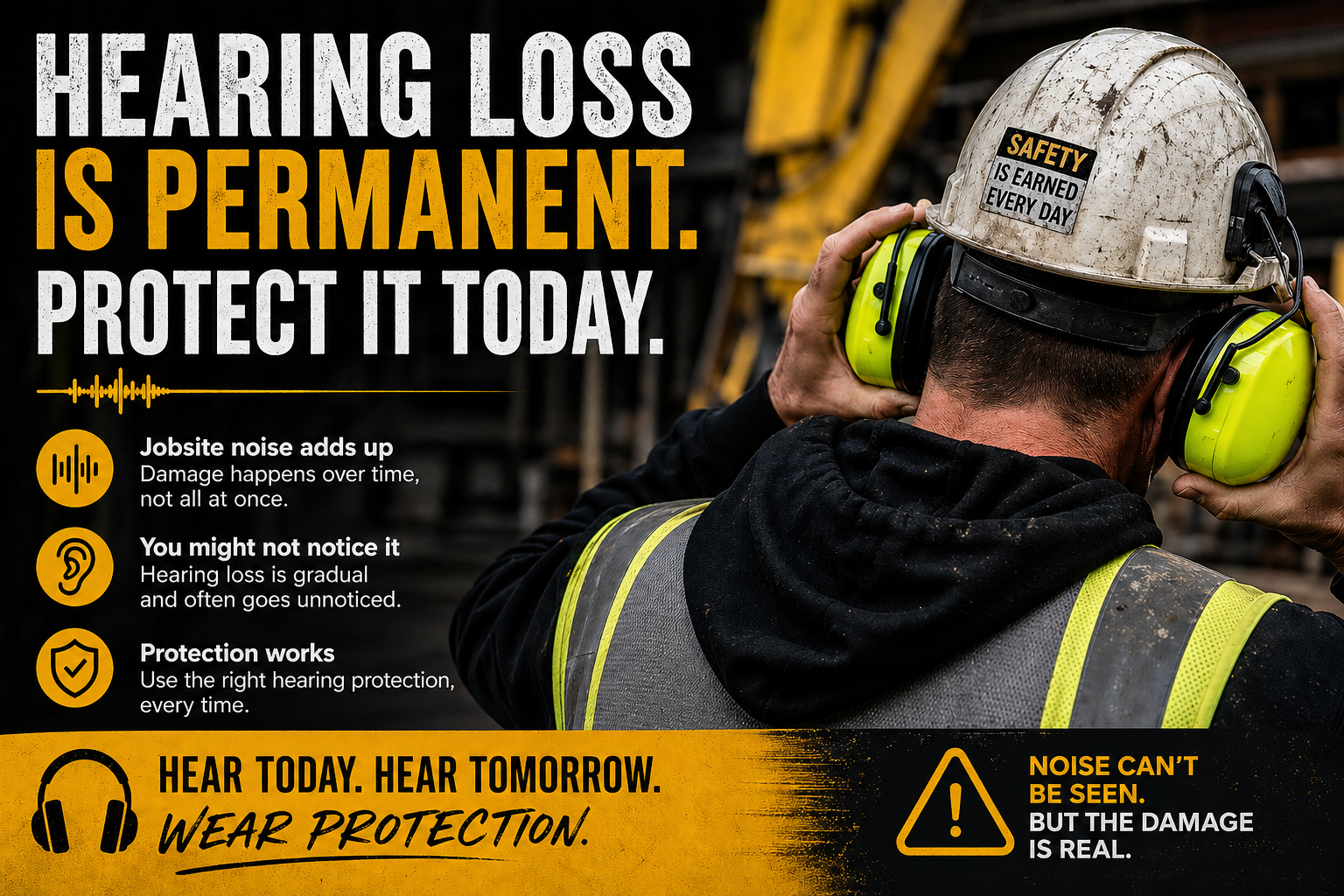
Hearing conservation is critical in construction and industrial safety. Prolonged exposure to high noise levels can lead to permanent hearing loss.
8–9 Minute Read
Hearing loss doesn’t happen all at once, and that’s why it gets ignored
Most hazards on a jobsite are immediate. A fall, a caught-in incident, or an electrical shock all have visible consequences that demand attention. Hearing loss is different. It builds slowly over time, which makes it easy to overlook, even though it’s one of the most common occupational hazards in construction and industrial environments.
Workers don’t notice it the day it starts. It shows up gradually. Conversations get harder to hear, background noise becomes overwhelming, and certain tones begin to fade. Because the damage isn’t immediate, it rarely gets treated with the same level of urgency as other risks, even though the outcome is permanent.
Jobsite noise is constant, and exposure adds up faster than people think
Most construction and industrial environments operate at noise levels that exceed safe limits. Equipment like grinders, saws, compressors, and heavy machinery routinely push sound levels well beyond what the human ear can handle over time. The issue isn’t just how loud something is in the moment, but how long workers are exposed to it throughout the day.
According to the Occupational Safety and Health Administration, sustained exposure to noise levels above 85 decibels can lead to permanent hearing damage. On most jobsites, that threshold is exceeded regularly, often without workers realizing how quickly exposure is accumulating.
“It’s not that loud” is one of the biggest misconceptions on a jobsite
One of the most common reasons hearing protection gets ignored is perception. If something doesn’t feel painfully loud, workers assume it’s safe. The reality is that hearing damage doesn’t require extreme noise levels. It requires consistent exposure.
A worker using a circular saw for short cuts throughout the day may not feel like they’re exposed to dangerous noise, but those repeated bursts add up. Someone operating equipment near running machinery may not think twice about it, but the background noise alone can exceed safe limits over a full shift.
The danger isn’t always obvious, which is why it’s often underestimated.
Temporary discomfort turns into permanent damage over time
After a long day in a noisy environment, it’s common for workers to notice ringing in their ears or a temporary reduction in hearing clarity. Most people treat it as normal and assume it goes away without consequence.
What’s actually happening is early-stage damage.
That ringing, often referred to as tinnitus, is a warning sign that the ear has been overstressed. Over time, repeated exposure leads to permanent damage, and once hearing is lost, it doesn’t come back. The gradual nature of the damage is what allows it to continue unchecked.
Hearing protection is often available, but not consistently used
On most jobsites, hearing protection is not the problem. Earplugs and earmuffs are usually provided and readily accessible. The issue is consistency.
Workers remove protection to communicate, forget to put it back in, or decide it’s unnecessary for short tasks. In some cases, improper fit reduces effectiveness, giving a false sense of protection.
Hearing conservation programs only work when protection is used correctly and consistently. Anything less turns a controlled hazard into an unmanaged one.
Communication challenges create another layer of risk
One of the reasons workers avoid hearing protection is the concern that it makes communication harder. On active jobsites, communication is critical, especially around heavy equipment and moving crews.
The solution isn’t to remove protection, but to improve how communication happens. Visual signals, clear procedures, and proper planning can reduce the need to rely solely on verbal communication in high-noise environments.
Without that adjustment, workers are forced to choose between hearing protection and situational awareness, which creates additional risk.
Long-term impact goes beyond the jobsite
Hearing loss doesn’t stay at work. It follows workers home.
It affects conversations with family, the ability to hear warnings or alarms, and overall quality of life. Unlike many jobsite injuries, hearing damage is permanent and continues to impact workers long after the job is done.
That’s what makes it one of the most serious, yet overlooked, hazards in the industry.
The crews that get this right treat noise like any other exposure
The contractors who manage hearing risks effectively don’t treat noise as background conditions. They treat it as exposure, just like fall hazards or energy control.
They identify high-noise tasks ahead of time, enforce hearing protection consistently, and make sure workers understand when and why it’s required. They also build communication methods that work with protection in place instead of around it.
That level of consistency is what prevents long-term damage.
Leadership sets the standard for what gets taken seriously
If hearing protection is treated as optional, it becomes optional. Workers follow what is enforced, not what is written in a policy.
When supervisors wear protection, enforce it, and address misuse immediately, it becomes part of the job. When it’s ignored, it quickly disappears from the worksite culture.
Like every other aspect of safety, consistency is what determines whether the risk is controlled.
A final thought from the field
Hearing loss doesn’t happen in a single moment, and that’s why it gets overlooked. It builds over time, quietly, until the damage is already done.
The risk is not complicated. It’s exposure and consistency.
The crews who take it seriously don’t wait until there’s a problem. They treat hearing protection the same way they treat every other hazard on the jobsite.
As part of doing the job right.