
Excavation competent person training prepares an employer to name someone for the trench. That person reads the ground, calls the soil, and stops the job when the cut, the water, or the protective system no longer looks safe. A cave-in does not give a crew time to debate the standard. The person watching the excavation needs enough knowledge to see the change, and enough authority to pull people out.
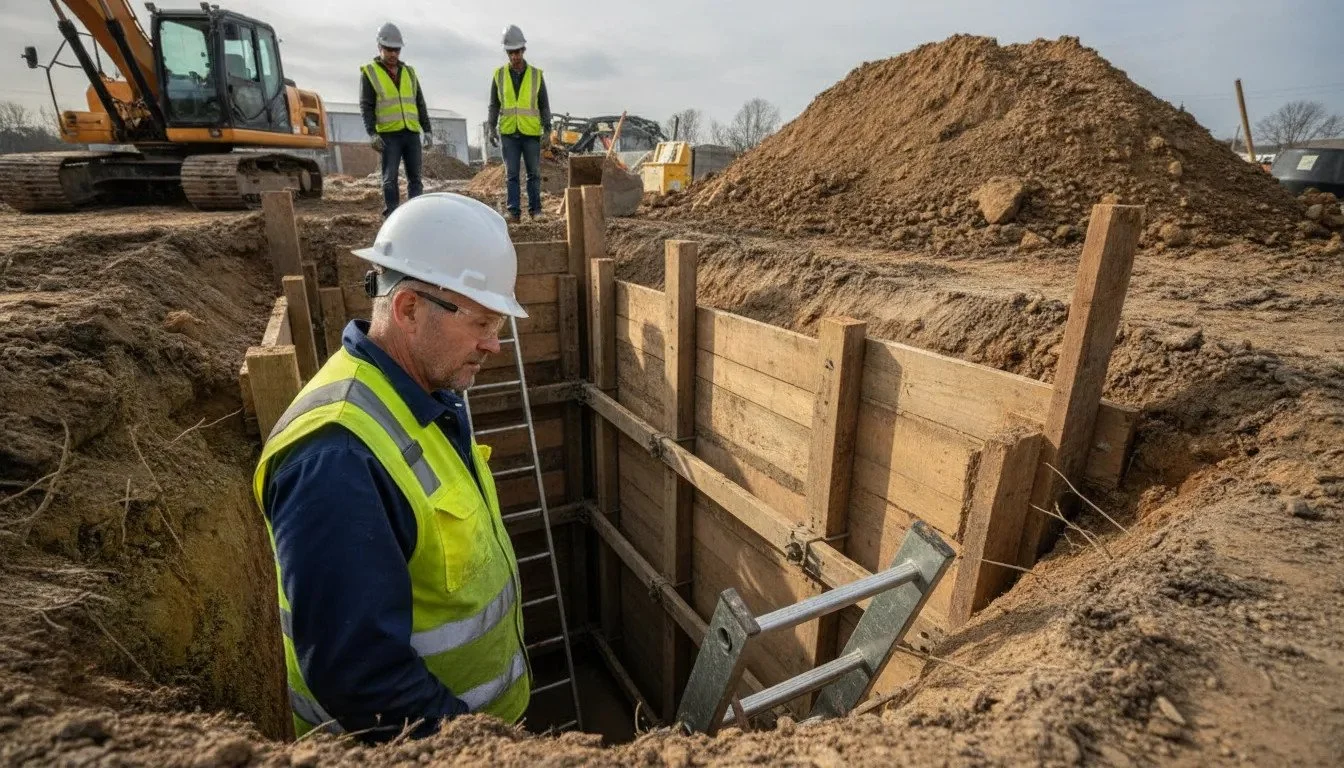
That role is not the same thing as a general awareness class. Kelly Safety's online trenching and excavation course is self-paced hazard training. It runs about 120 minutes of video, and completion time varies by student. The course covers cave-ins, falling loads, hazardous atmospheres, and equipment. It also covers entry and exit, plus protective systems such as shoring, shielding, and sloping. It helps workers and supervisors recognize the hazards. It does not inspect a trench or classify the soil on a live job. It does not designate anyone as the competent person. The employer still matches the person to the site and keeps the authority to correct the work.
What excavation competent person training has to cover
OSHA's construction definition is short and easy to under-read. A competent person can identify existing and predictable hazards in the surroundings or working conditions. That same person must be authorized to take prompt corrective measures to eliminate them. Both parts have to be true. Knowledge without authority is an advisor. Authority without the ability to read the excavation is a title on a sign-in sheet.
Subpart P uses that person for specific decisions, not as a general safety slogan. The excavation rules sit in 29 CFR 1926.650 through 1926.652. 29 CFR 1926.650 defines the role, a cave-in, a trench, and the protective systems crews actually use. 29 CFR 1926.651 assigns the daily inspection, the water watch, and the order to remove exposed employees. 29 CFR 1926.652 is where the protective-system choice lives. The shallow-excavation exception still depends on a competent person's look at the ground.
For contractors, the practical version is this. Before the bucket goes in the ground, someone on that job can answer four questions:
What could bury, strike, or overcome a worker in this excavation today?
What soil and site conditions drive the protective system we are using?
What changed since the last inspection, including rain, vibration, water, or a deeper cut?
Do I have the authority to stop entry until that change is fixed?
If the answer to the last question is no, excavation competent person training has not landed yet. The class may be finished. The designation is not.
How this differs from general excavation awareness
General excavation awareness teaches a crew what a cave-in looks like and why a trench box is not optional scenery. That training matters. New hires, laborers, and operators need it before they work around an open cut. It is also the right place to send someone who needs a shared vocabulary for sloping, shielding, and safe access.
Competent-person preparation goes one step further. It is about the decisions the standard assigns to one authorized person on that site. Those decisions include when to inspect, when a soil call is no longer valid, when water-removal equipment has to be watched, and when people come out of the hole. A worker can finish hazard training and still not be the person the employer has authorized to make those calls.
The same split shows up in other OSHA roles, and the standards should stay apart. Fall protection has its own competent-person duties and its own training record rules. Confined-space work uses entrant, attendant, and supervisor roles. Its atmospheric testing is not the same assignment as an excavation inspection. Focus Four training is a broad look at falls, electrocution, struck-by, and caught-in/between hazards. Caught-in/between includes cave-ins. A Focus Four module is still not a substitute for Subpart P duties on a utility crew.
Kelly Safety keeps those as separate courses: OSHA Focus Four, confined space entrant, attendant, and supervisor, and the trenching course already linked above. Use the one that matches the work. Do not treat one completion record as coverage for every role.
Online, live virtual, and on-site delivery are also different products. Kelly Safety offers self-paced OSHA and MSHA training nationwide, with live virtual and on-site options when a contractor needs them. An online course can build the knowledge base. It cannot see the spoil pile, the water in the invert, or the loader working the edge. That part stays on the job.
Inspection duties that training has to make concrete
The inspection rule is the heart of the role. Under 1926.651(k), a competent person inspects the excavation, the adjacent area, and the protective systems. The look is for a possible cave-in, a failing protective system, a hazardous atmosphere, or any other hazardous condition. The inspection happens before work starts and as needed through the shift. It also happens after every rainstorm and after any other event that increases the hazard. The duty applies when employee exposure can reasonably be anticipated. It is not a paperwork ritual on an empty cut nobody will enter.
Training should walk through what "as needed" looks like on a real crew, not just the sentence in the standard. A useful session uses the jobs the company actually runs:
A utility trench that starts at three feet and is deepened after lunch.
A rainy afternoon that softens the banks and loads the spoil pile.
A vacuum or excavator set close enough to surcharge the wall.
A shield that was set for yesterday's depth and is now sitting above the new invert.
Vibration from traffic, pile driving, or a compactor on the shoulder.
If the inspection finds evidence of a possible cave-in, a failing system, a hazardous atmosphere, or another hazardous condition, exposed employees come out until the precautions are in place. That is the stop-work authority. Training that never practices the sentence "everybody out, we are not entering until this is fixed" has skipped the part OSHA wrote into the rule.
Several neighboring duties belong in the same briefing. They are also competent-person calls under 1926.651.
Structural ramps used only by employees for access or egress are designed by a competent person. Equipment ramps need a competent person qualified in structural design.
If water is being pumped out, a competent person monitors the water-removal equipment and the operation.
When the cut interrupts natural drainage, or heavy rain can run into it, a competent person inspects excavations subject to that runoff.
Employees do not work in accumulated water unless precautions fit that situation. Those precautions can include a special support or shield, water removal, or a harness and lifeline. The standard does not treat one control as universal.
Access rules belong in the same conversation even when they are not labeled as a competent-person design. In a trench 4 feet or deeper, a stairway, ladder, ramp, or other safe exit has to be within 25 feet of lateral travel. Training should make the crew check that distance after the trench is extended, not only when the first ladder goes in.
Soil and protective-system decisions
Protective systems are how the employer keeps a cave-in from becoming the emergency plan. 1926.652 requires an adequate protective system except in two cases. One case is an excavation made entirely in stable rock. The other is an excavation less than 5 feet deep. It applies only after a competent person examines the ground and finds no indication of a potential cave-in. "Less than 5 feet" is not a free pass. It is an examination. Fissures, water, vibration, previously disturbed soil, or a spoil pile on the lip can all say the shallow cut still needs protection.
When Appendix A is used for sloping, benching, or certain shoring, a competent person classifies each soil and rock deposit. The choices are stable rock, Type A, Type B, or Type C. The classification uses at least one visual analysis and at least one manual analysis. That is a field skill. It is not a guess based on last week's trench two miles away.
The categories get weaker as the ground gets less reliable. Type A is cohesive soil with an unconfined compressive strength of 1.5 tons per square foot or greater. Examples include clay, silty clay, and cemented soils such as caliche and hardpan. It is not Type A if it is fissured. Vibration from heavy traffic or pile driving also keeps it out of Type A. So does previous disturbance. Layers that slope into the cut at 4 horizontal to 1 vertical or steeper do the same.
Type B includes cohesive soil between 0.5 and 1.5 tsf and some granular cohesionless soils. It also includes previously disturbed soil that is not Type C, and soil that would have been Type A except for fissures or vibration. Type C includes cohesive soil at 0.5 tsf or less. It also includes gravel, sand, and loamy sand, submerged soil or soil that is freely seeping, and unstable submerged rock.
A competent person trained only on a clean Type A example will mis-call real ground. Last year's trench shoulder, a bank next to a haul road, or a bottom that starts seeping can all be weaker than the textbook sample. Those conditions move the classification toward a less stable type. The protective system has to move with it.
The employer, or the employer's designee, selects and constructs the system. Subpart P allows several design paths. Training should name them. One handout does not replace the appendices.
Slope no steeper than 1.5 horizontal to 1 vertical, the Type C configuration in Appendix B, unless another allowed option is used.
Use Appendices A and B to match the maximum allowable slope to the soil classification and the conditions in those appendices.
Use other tabulated data that is in writing, states its limits, and identifies the registered professional engineer who approved it. Keep a copy at the jobsite while the system is being built.
Use a design approved by a registered professional engineer for that project, also in writing and kept at the jobsite during construction.
Support systems, shields, and other protective systems have their own options. Those include the timber and aluminum hydraulic shoring appendices and manufacturer tabulated data. A trench shield protects people inside it only when it is used within its tabulated limits. It also has to be set for the depth and soil in front of the crew. Workers still need protection while they enter and leave. Training should include the failure signs. Look for gaps under the shield, panels riding above the bottom, missing struts, and soil sloughing in behind or below the box.
This is also where online content has a hard stop. A video can show a thumb test, a ribbon test, and a properly set shield. It cannot classify today's deposit or approve a site-specific sloping plan. If the job needs tabulated data or an engineer, training should teach the person to ask for that document. People stay out until it is on site. Nobody should invent a slope from memory.
Match the training to the site you actually run
The phrase "competent person training" gets treated like a product with a fixed outline. Subpart P does not work that way. The knowledge has to match the excavations, equipment, and protective systems the employer uses. A crew that only sets manufacturer trench shields needs a different practice block than a crew that slopes large open cuts or benches in mixed soil. Both still need the inspection and removal rules.
Before you call a course complete for this role, compare the outline with the work:
Soil types and the visual and manual checks your jobs actually allow.
The protective systems on your trucks, including the tabulated data that rides with each shield or shore.
Access, spoil placement, and surface encumbrances on the streets and easements you dig.
Water, rain, and groundwater conditions in your region.
Hazardous atmospheres where you dig in landfills, near stored hazardous substances, or in deeper cuts. Below 19.5 percent oxygen is oxygen deficiency. In an excavation deeper than 4 feet, 1926.651 requires testing before entry where that condition, or another hazardous atmosphere, exists or could reasonably be expected.
Underground installations. Estimated locations of sewer, phone, fuel, electric, water, and other utilities have to be determined before the excavation is opened. Utility owners are contacted and asked to mark them. As the dig approaches a mark, the exact location is found by safe means, and open installations are protected, supported, or removed as needed. Training should cover what the competent person does when the marks and the ground do not match.
Who may stop the job, and who backs that call when a superintendent wants the pipe in before the storm.
Employers who run several crews often need more than a single enrollment. Kelly Safety's contractor safety-management memberships cover the ongoing side of the work. Members get a training library, weekly toolbox talks, and customizable checklists, forms, and policies. The plan level depends on crew size. Membership does not designate a competent person. It can keep the refresher, the toolbox topic, and the inspection form in circulation after the first course.
Where the need is a written program, a field audit, or help on a bid, contractor safety consulting is a separate conversation. Consulting scope follows the request. It is not included automatically with a course seat.
Spanish-speaking crews have a related but different path. The Spanish training catalog includes excavation and trenching hazard training. That supports comprehension for the crew. It still does not, by itself, name the competent person or translate a site-specific soil call. If the authorized person and the crew do not share a language, the employer has a communication problem to solve on that job, not a box the catalog can check.
A field checklist for the person you authorize
Use this as a pre-task and return-to-work list. It is a prompt for the competent person and the supervisor. It is not a completed inspection, a certification, or proof that a particular trench met Subpart P.
Confirm who is the competent person on this excavation today, and that this person can stop entry.
Confirm estimated utility locations were determined and the utility owners were contacted before the cut. The crew needs a plan for when the dig does not match the marks, including safe means to find the exact location.
Remove or support surface encumbrances that could hit employees. Check spoil, tools, and equipment are placed so they cannot roll or fall into the excavation.
Look at depth, width, and whether the cut is now a trench. Re-measure after any change. Do not carry forward this morning's number.
Examine the ground. Note fissures, layered soil, previously disturbed backfill, vibration, and seepage. If Appendix A applies, record the visual test, the manual test, and the classification.
If the excavation is under 5 feet, document the competent person's examination and whether any cave-in indication was present. If any indication is present, protect the employees.
Match the protective system to the soil, depth, and tabulated data or engineer design. Check that the required copy is on the job while the system is built.
Check sloping angles, bench steps, shore struts, and shield set. Look under and behind the system for lost soil.
Confirm a safe exit within 25 feet of lateral travel in any trench 4 feet or deeper. Recheck after the trench is lengthened.
Test the atmosphere before entry where a hazardous atmosphere may exist in an excavation deeper than 4 feet. Re-test as conditions change.
If water is present or rain is loading the banks, keep people out until precautions match 1926.651(h). Monitor pumps if they are the control.
Walk the adjacent area: traffic, mobile equipment near the edge, and any walkway crossing the excavation. Equipment without a clear view of the edge needs a warning system such as barricades, signals, or stop logs.
After rain, vibration, a struck line, a deeper cut, or any other hazard-increasing change, inspect again before anyone goes back in.
If you see a possible cave-in, a failing system, a hazardous atmosphere, or any other hazardous condition, remove exposed employees until the fix is in place.
Tell the foreman what changed and what has to happen before entry resumes. Leave a record your company can find after the job, not a note that lives in one person's pocket.
Supervisors can turn that list into the toolbox topic for the week a crew starts trench work. The point is the second look after conditions change, not a signature collected at 6 a.m. and forgotten at noon.
What completion does not decide
Say this plainly in the class and in the course record. Completing excavation competent person training does not make the learner a competent person. That includes Kelly Safety's trenching and excavation course and any other online module. Completion does not classify soil or approve a protective system. It does not satisfy a site-specific engineer design. It also does not guarantee that a general contractor, owner, or client will accept the person on their site.
The employer makes the designation. OSHA's definition requires both capability and authorization to take prompt corrective measures. A provider can teach the standard, show the tests, and issue its own completion documentation for the course the student finished. The provider cannot stand at the trench on Thursday and pull the crew out. That authority has to be real inside the company. If a superintendent can overrule the competent person and send people back into a cut the competent person rejected, the authorization is not real.
Keep the paperwork specific. Record the course name, the delivery mode, the language, and the date. Also record the hours or video time the provider actually states. Kelly Safety's trenching page states about 120 minutes of video and 0.2 CEU. Duration is estimated by student. Those figures belong to that course. They are not a universal length for this role, and they are not an OSHA card. Outreach cards, provider certificates, and employer-designation records are different documents. Do not staple them together and call the packet a license. There is no such license in Subpart P.
State rules, client prequalification portals, and project specifications can ask for more than the federal excavation rules. This article does not map those add-ons. If a bid or a host employer names a particular class, a particular refresher interval, or a written designation letter, follow that requirement in addition to Subpart P. When the ask is unclear, contact Kelly Safety and ask which course or support option matches the work. The public line on the site is (205) 202-0882. Asking which seat to buy is not the same thing as asking OSHA to accept a designation.
How employers should build the training
A practical program has three layers. Skip one and the file looks complete while the trench is still unmanaged.
Knowledge. Cover the Subpart P definitions, the inspection triggers, and soil classification limits. Include protective-system options, water and atmosphere rules, access, utilities, and removing exposed employees. The OSHA-aligned course catalog is the broader library if the same crew also needs Focus Four, confined space, or fall prevention. Keep this training pointed at the trench duties. Send people to the other courses for the other hazards.
Site practice. Walk a cut your company actually digs. Have the learner classify a deposit, read the tab data on your shield, measure the ladder distance, and call a stop when you change the scenario. Rain, a deeper invert, and a spoil pile on the edge are fair tests. A slide deck alone will not show you whether the person will make the call in front of a waiting crew.
Authorization. Put the designation in writing for the person and the type of excavation. Say they can remove employees and stop entry. Tell the foremen. Review it when the person changes roles, when you add a new protective system, or when an inspection shows the calls are late. Retrain when the work changes, not on a random anniversary that has nothing to do with the soil.
Contractors who already run several jobsites usually feel the gap between layer one and layer three. The course is easy to buy. The authorization is a management decision. That is why this topic sits next to safety-management support instead of inside a single enrollment button. The person in the hole still needs a named competent person on that shift, with a phone number that gets answered.
FAQ
Does excavation competent person training replace a trenching awareness course?
No. Awareness training gives the crew a common picture of cave-ins, access, and protective systems. Competent-person preparation is for the person the employer will authorize to inspect, classify conditions, and stop the work. Most crews need the awareness course for people in and around the excavation. They also need a separate designation for the person accountable under Subpart P.
Is there a required number of hours?
Subpart P does not set a universal hour minimum for naming an excavation competent person. Kelly Safety's trenching and excavation course is about 120 minutes of video, and that time describes that course only. Hour counts from another provider, or from OSHA 10 or OSHA 30, do not by themselves satisfy the role. The employer still has to judge capability against the sites, soils, and systems in use.
Can an online course make someone the competent person?
No. Online training can teach the rules and the tests. The employer designates the competent person and has to give that person authority to take prompt corrective measures, including removing employees from the excavation. Finishing a module, including a Kelly Safety course, is not that designation.
Who classifies the soil?
When Appendix A is used, a competent person classifies each soil and rock deposit as stable rock, Type A, Type B, or Type C. The call uses at least one visual analysis and one manual analysis. Fissures, vibration, previous disturbance, and seeping water can move soil into a weaker category. If the system relies on tabulated data or a registered professional engineer, that document has to match the excavation in front of the crew.
When do people have to get out of the trench?
As soon as the competent person finds evidence of a possible cave-in, a failing protective system, a hazardous atmosphere, or any other hazardous condition. They stay out until the necessary precautions are in place. The same idea applies before the shift starts, after rain, and after any other change that increases the hazard.
If your crews are entering excavations this season, review the trenching and excavation course for hazard awareness. Then decide in writing who on each job can stop the work. Call (205) 202-0882 if you want help matching the course to the crew.
