
OSHA 10 vs OSHA 30: Which Card Do You Need?
Choosing between OSHA 10 vs OSHA 30 comes down to your role, the work you will perform, and the requirements set by your employer or jobsite. OSHA 10 is the shorter Outreach Training course often selected for workers, while OSHA 30 is a more extensive option often selected for supervisors and people with safety responsibilities. Neither choice is right for every person, and a card alone does not establish that you meet every employer, state, local, or project-specific requirement.
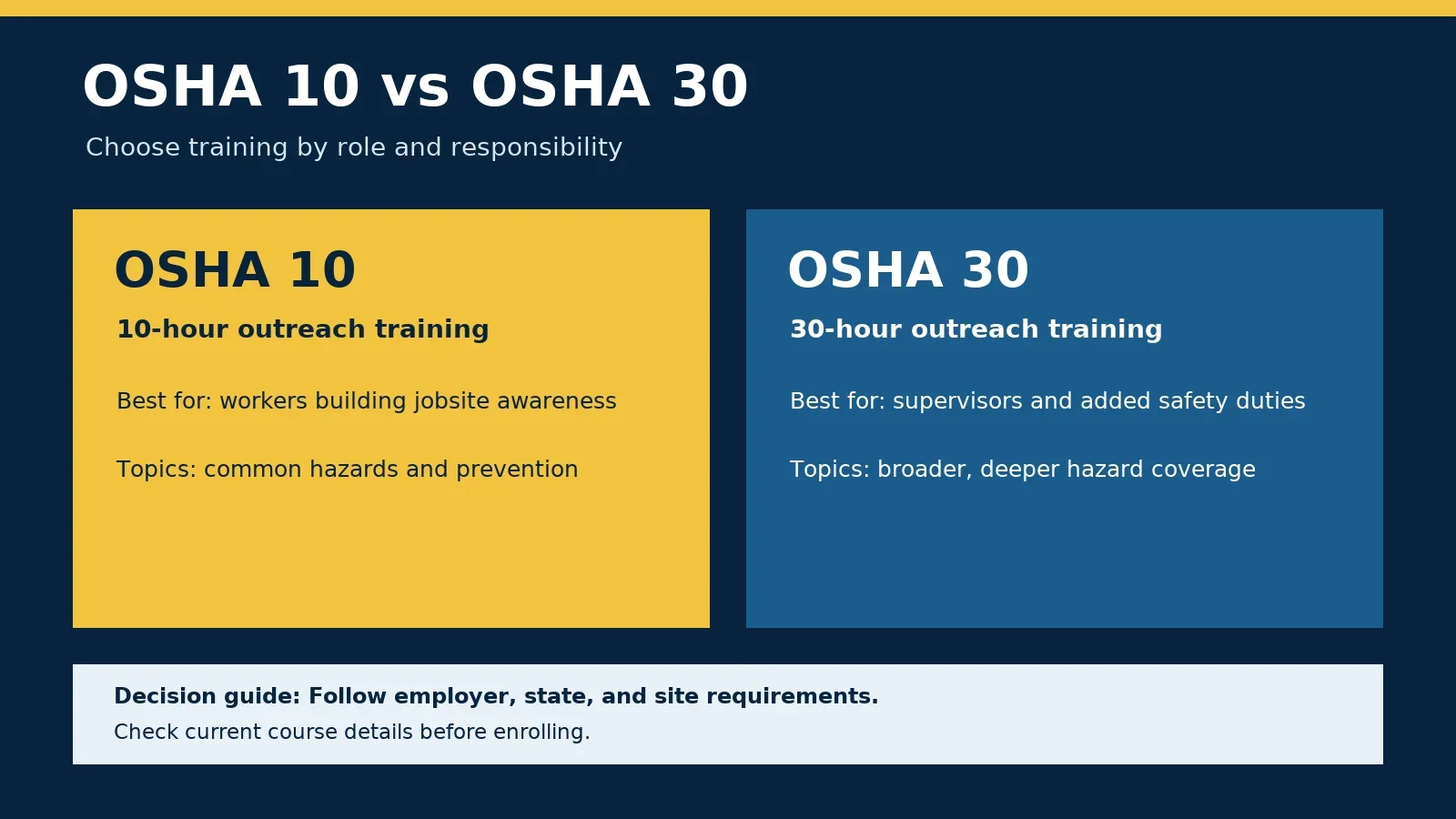
OSHA 10 vs OSHA 30 at a glance
The numbers refer to the intended course hours, not a score, experience level, or number of subjects. OSHA 10 is a 10-hour Outreach Training course. OSHA 30 is a 30-hour course. Both are designed to introduce safety and health topics relevant to a particular industry, such as construction or general industry. The exact curriculum depends on the course version.
A common starting point is to think about the work relationship: are you mainly learning to recognize hazards and follow safe work practices, or do you also oversee other workers, coordinate work, or help manage safety? That distinction can point you toward a useful course, but it cannot override an employer’s rule or a jobsite’s acceptance requirements.
Course length: OSHA 10: 10 hours; OSHA 30: 30 hours
Common audience: OSHA 10: Workers seeking an introduction to workplace hazards and prevention; OSHA 30: Supervisors, foremen, safety leads, and workers who need broader instruction
Scope: OSHA 10: Introductory coverage of selected safety and health topics; OSHA 30: Broader and more in-depth coverage of selected safety and health topics
Kelly Safety listed construction course price: OSHA 10: $59; OSHA 30: $159
Best first check: OSHA 10: Confirm that a 10-hour course and the specific industry version meet the requirement; OSHA 30: Confirm that a 30-hour course and the specific industry version meet the requirement
The prices above are the listed amounts in this article’s course brief for Kelly Safety’s construction options. Course pricing and availability can change. Check the current course page before enrolling, and do not assume a listed construction course price applies to a general-industry or other course.
Also compare the time commitment with the reason for training. A 10-hour course is shorter to schedule, but it is not a shortcut if a job requires the 30-hour version. A 30-hour course involves more time away from other tasks, but that added time is worthwhile only if it fits the learner’s needs and is accepted for the purpose. For a crew, account for the time each person needs to complete the course, how work will be covered during training, and when documentation must be ready.
What the course hours tell you—and what they do not
The 10-hour and 30-hour labels describe the length of the Outreach Training curriculum. They do not mean that a worker has completed every safety course needed for every task. Neither course replaces job-specific instruction, employer procedures, hazard assessments, required qualifications, or training that applies to a particular piece of equipment or work activity.
Both courses are intended to help learners recognize workplace hazards and understand prevention practices. The 30-hour course has more time available for instruction and a wider opportunity to explore topics. That does not make it a universal substitute for targeted instruction. For example, a worker assigned to a specific high-hazard task may still need focused training and hands-on direction from the employer before doing that task.
The word “card” is commonly used to describe the completion card associated with an Outreach Training course. It is useful to ask what the person requesting training means by “card”: which industry, which course length, which issuing or training arrangement, and whether any timing or documentation rules apply. Do not assume that any safety card, certificate, or course completion record is interchangeable with a requested Outreach Training card.
Who usually considers OSHA 10?
OSHA 10 is often a sensible first course for workers who need a broad introduction to safety and health topics in their industry. It can help a new worker learn to notice common hazards, understand basic prevention concepts, and communicate more effectively about safety expectations. It may also be the right choice for an experienced worker if a job, employer, or project specifically asks for a 10-hour course.
For construction workers, the course version matters. Construction work has hazards and practices that differ from those in general industry. If your work is in a plant, warehouse, manufacturing setting, or another non-construction environment, confirm whether the general-industry version is the one your employer wants. Kelly Safety offers OSHA training options; check the course details and version before choosing.
OSHA 10 may be a practical fit when:
You are entering a job or industry where introductory safety education is requested.
Your employer or project has specified OSHA 10, rather than OSHA 30.
You need a broad introduction and do not have supervisory or safety-coordination duties that call for broader training.
You are comparing courses for a team and want to match course length to each worker’s responsibilities.
These are decision cues, not a promise that a particular employer or site will accept a particular course. Ask the party setting the requirement to confirm the exact course type and documentation they need.
Consider a new construction laborer whose contractor asks for an introductory safety course before the first assignment. If the contractor confirms that OSHA 10 Construction meets the requirement, choosing OSHA 10 may be the direct fit. Now consider a crew lead who is asked to coordinate workers and reinforce safe practices. OSHA 30 Construction may provide broader foundational instruction, but the lead should still verify whether the employer or project names a specific course. These examples show how responsibilities help frame the question without replacing confirmation from the person who set the requirement.
For an individual worker paying for a course, ask before enrolling if the training is connected to a specific job offer or project. A recruiter or coworker may use informal language, while the employer’s written requirement may name an industry version or course duration. Getting that detail in writing helps you avoid paying for a course that does not match the request.
Who usually considers OSHA 30?
OSHA 30 is often considered by supervisors, foremen, crew leads, safety coordinators, and other people whose responsibilities extend beyond their own tasks. It offers more instructional time than OSHA 10, which can be useful for learners who need broader exposure to workplace safety subjects or who are expected to help communicate and reinforce safety practices.
A worker does not have to hold a management title to ask about OSHA 30. Some employers or projects may request it for a particular position or assignment. Conversely, a supervisor should not assume that a 30-hour course is automatically required simply because of a title. The role, employer policy, applicable rules, and jobsite conditions determine what is needed.
OSHA 30 may be worth considering when:
You supervise work or coordinate a crew and want broader foundational safety instruction.
Your employer, customer, or project has specifically requested the 30-hour course.
You are responsible for discussing hazards and safe work practices with other workers.
You want a longer course that allows more time for learning across selected safety and health topics.
More course hours do not confer authority to approve work, conduct every required inspection, or replace competent-person duties where those apply. Training is one part of a larger safety program. Employers remain responsible for determining and providing the instruction, procedures, and oversight appropriate to the work.
A supervisor evaluating the two courses should consider what they will do after class. Will they need to talk through hazards before a task, guide workers to follow company procedures, or identify when an issue needs escalation? A broad course can provide useful shared concepts, but it does not create site-specific expertise by itself. Employers should pair general education with clear expectations, access to qualified guidance, and information about the actual work environment.
How do the topics differ?
OSHA 10 and OSHA 30 share the goal of helping participants understand workplace safety and health. They differ primarily in course length and breadth. The exact subjects depend on whether the course is for construction or general industry, and on the course curriculum. Review the specific course outline rather than relying on the number alone.
Construction training commonly addresses hazards that can arise on jobsites, such as falls, struck-by hazards, caught-in or between hazards, and electrical risks. General-industry training is oriented toward hazards found in settings such as manufacturing, warehousing, and other ongoing operations. The examples and emphasis should match the course version and actual work environment.
A 10-hour course introduces a selection of topics within its planned duration. A 30-hour course allows more time and broader topic coverage, but it still cannot cover every hazard at every workplace in detail. Employers should identify task-specific risks and provide any additional instruction employees need to perform the work safely.
Before signing up, ask these questions about curriculum:
Is the course designed for construction or general industry?
Does its topic coverage fit the hazards and work setting I expect to encounter?
Are any focused subjects, practical demonstrations, or site-specific orientations needed in addition?
Does the employer or project require a particular course or training arrangement?
If you already know the subject you need to study, a focused course may be a better supplement than choosing OSHA 30 simply because it includes more hours. For example, Kelly Safety offers topic-specific resources for fall prevention and lockout/tagout. These subjects do not replace an employer’s task-specific training or safe-work procedures.
Does OSHA require you to take OSHA 10 or OSHA 30?
Do not assume that every worker in the United States is required to complete OSHA 10 or OSHA 30. Outreach Training is not a universal credential requirement for every job. At the same time, employers, project owners, state or local rules, or other applicable requirements may call for a particular course for certain workers or assignments. The answer depends on the actual requirement that applies to you.
Requirements can differ by location, industry, project, employer, and job duties. A contractor bidding on a project may encounter customer or site-entry conditions that are stricter or more specific than the general minimums that apply elsewhere. A worker may also need training for specific tasks in addition to an Outreach course. A general article cannot determine which conditions govern a particular worksite.
Before enrolling, get the requirement in clear terms from the employer, site contact, or organization that will review the training. Ask whether it calls for OSHA 10 or OSHA 30, construction or general industry, a specific course provider or format, and any deadline or documentation. If requirements are written into a contract or project orientation, compare the course details with those instructions.
For employers coordinating a crew, keep a record of what was requested and how each worker’s course was selected. This can prevent a common mix-up: ordering a course that sounds close to the requested training but differs in duration or industry version. If a worker has already completed a course, verify acceptance before assuming it satisfies a new project’s requirements.
It helps to distinguish three questions that are sometimes bundled together: what the law or applicable rule calls for, what the employer requires as its own policy, and what a particular customer or site will accept. The answer to one does not automatically answer the others. An employer may choose to require broader education for its workforce, while a project may set a separate entry condition. Workers should follow the requirement that applies to the assignment and ask their employer how overlapping conditions are handled.
For a worker moving between industries, prior experience is useful but does not decide which course is requested. Someone with years in a warehouse who is starting construction work may need to check the construction course requirement. A construction worker taking a manufacturing assignment should ask whether general-industry training or other instruction is expected. The relevant comparison is the course and workplace in front of the worker, not simply the one completed most recently.
For an employer, the decision can also depend on how responsibilities are distributed. A small crew may have a working foreman who performs tasks alongside the team, while a larger operation may assign a separate safety lead. Both people may benefit from safety education, but their day-to-day duties are not identical. Identify who needs basic awareness, who coordinates work, and who needs specialized instruction; then confirm the required course for each role rather than treating rank as a complete answer.
If a worker already has an OSHA 10 card and is later asked for OSHA 30, do not assume that the earlier course automatically reduces the time or requirements of the second one. Ask the training provider and the requesting employer what course and completion process apply. Likewise, if a worker has OSHA 30 but a form asks for OSHA 10, ask whether the longer course is accepted instead. Similar names do not guarantee that one record substitutes for another under every employer’s policy.
How much do OSHA 10 and OSHA 30 cost?
In Kelly Safety’s listed construction course pricing provided for this article, OSHA 10 is $59 and OSHA 30 is $159. That means the OSHA 30 option costs more and requires three times the listed instructional hours. Price alone should not decide the choice: the proper comparison is the course that the employer or project will accept and that matches the learner’s role.
Use the relevant course pages to confirm current details: OSHA 10 construction and OSHA 30 construction. If you need general industry, Spanish-language access, or another variation, verify the individual course page rather than assuming that the same listed amount or course conditions apply. Prices and course offerings may be updated.
For an employer comparing team options, consider the total training plan, not only the per-person amount. Confirm who needs which course, whether everyone is expected to complete the same version, and whether any additional job-specific instruction is needed. A mixed workforce may have different training needs based on duties, project conditions, and customer requirements.
One way to keep the comparison manageable is to separate course costs from the time needed to arrange and complete training. For individual learners, that means checking how the course is delivered and when the completion record will be available. For a business, it means deciding how to schedule employees, whether learning time overlaps with critical operations, and who will confirm that every assigned person finished the correct course. These practical considerations do not change the course requirement, but they can help avoid last-minute delays.
When a customer or project asks for documentation, clarify what evidence it wants and how it should be submitted. A worker may have completed training but still need to retrieve a card or completion record before onboarding. Employers can reduce confusion by sharing the submission deadline, contact person, and recordkeeping process when they assign courses. Avoid promising that a record will meet an acceptance rule until the responsible party confirms it.
How to choose the right course in five steps
Get the requirement. Ask the employer, project owner, or site contact what training is required. Request the exact course length and industry version instead of relying on informal shorthand.
Match the course to the work. Consider whether the work is construction or general industry and what hazards and duties the learner will encounter. Select a course whose focus makes sense for that setting.
Consider the learner’s responsibilities. A worker seeking foundational awareness may be well served by OSHA 10 when that course is accepted. Someone overseeing others or seeking broader instruction may consider OSHA 30, especially if required by the employer.
Check course details and acceptance. Review the course page, delivery format, completion process, and any conditions that matter to the employer or project. If acceptance is uncertain, ask before purchasing.
Plan the additional training. Identify site orientation, task-specific instruction, or other training that may be needed after the course. Document training as required by the employer’s procedures.
This process avoids choosing based on a job title, a coworker’s experience, or the assumption that more hours always solve the problem. It also gives individual workers a clear way to ask an employer for the information needed before enrolling.
For employers: assigning training across a crew
Employers and contractors may need to organize training for people with different roles, experience, and assignments. A single course choice for everyone can be convenient, but it may not be the best fit for each worker. Start by listing the actual work and the requirements imposed by customers, site owners, or applicable rules. Then match training to those needs.
A simple training matrix can help track decisions:
Worker or role: identify the group or position, without assuming everyone performs the same tasks.
Work setting: note construction, general industry, or another context that affects the course version.
Requirement source: record whether the need came from an employer policy, project condition, or other applicable requirement.
Selected course: note the course length and version, then confirm the learner completed it.
Remaining needs: list site orientation, task instruction, or other training that the course does not cover.
This approach is especially useful when contractors work at multiple sites. A card accepted for one project may not automatically meet another project’s conditions. Before mobilizing a crew, verify the current site requirements and make a plan for any additional orientation or training. Keep records according to the employer’s process.
When several employees need training, organizations may also want to ask about group or contractor support rather than managing every course separately. Kelly Safety provides contractor safety-management membership information for organizations looking for ongoing safety support. Confirm current offerings and scope directly; a membership or course does not remove an employer’s responsibility to assess work and meet applicable requirements.
Online training and practical expectations
Online access can help workers and organizations arrange learning without gathering everyone in one classroom. Before enrolling, check the specific course’s delivery details and completion requirements. Self-paced access may be convenient for dispersed crews or individuals balancing work schedules, but learners still need to set aside the time to complete the course and understand its material.
Plan for uninterrupted study time, reliable access to the course, and a way to save or retrieve completion documentation. If an employer needs proof by a certain date, set the course deadline early enough to resolve login or documentation questions. For employees whose first language is Spanish, confirm whether an available Spanish-language course matches the required industry and course length. Kelly Safety lists Spanish safety training options; verify the specific course and acceptance with the employer or site.
Regardless of delivery method, online coursework is not a substitute for communication about local hazards. Supervisors should connect general learning to the site, equipment, procedures, and emergency practices workers will encounter. Workers should ask questions when a course topic does not answer how a particular task is supposed to be done.
Common mistakes when comparing OSHA 10 and OSHA 30
Choosing by the number alone. The hour count does not tell you whether the course version matches the industry or project.
Assuming OSHA 30 is always better. More hours may be useful for some learners, but the appropriate course depends on the requirement and role.
Assuming a card guarantees access. Employers and sites may apply their own acceptance conditions. Confirm those conditions before paying for training or arriving at a jobsite.
Treating Outreach training as task qualification. A general course does not automatically qualify someone to operate equipment, perform specialized work, or carry out every safety duty.
Using one course for every hazard. Additional focused instruction and site-specific direction may be necessary, depending on the work.
Ignoring course version and language. Construction and general-industry courses are not interchangeable by name alone, and workers should confirm they are enrolling in the version they need.
Relying on outdated price information. Check the course page for current pricing and details before registering.
When in doubt, pause and ask the party requiring training to confirm the exact course. A short clarification before enrollment can prevent a mismatch and help the worker arrive better prepared.
Frequently asked questions
Is OSHA 10 enough for a construction worker?
It may be enough when the employer or project accepts OSHA 10 for the worker’s role and the construction course matches the requirement. It is not possible to determine acceptance from the course name alone. Confirm the exact requirement and whether additional site or task-specific instruction is needed.
Should a foreman take OSHA 10 or OSHA 30?
A foreman may consider OSHA 30 because it provides more instructional time and is often selected for supervisory responsibilities. But a job title alone does not establish a universal requirement. The employer or project may specify OSHA 10, OSHA 30, another course, or additional training.
Can I take OSHA 30 instead of OSHA 10?
Do not assume a 30-hour course will satisfy a requirement written specifically for a 10-hour course, or vice versa. Ask the employer or site contact whether it accepts the course you plan to take. The industry version and any other acceptance conditions matter too.
Does OSHA 30 make someone a safety professional?
No. Completing a course is not the same as earning a professional credential or becoming qualified for every safety role. It provides training within its stated scope. Employers still need to assign responsibilities appropriately and provide any additional training or support required for the work.
Can I use an OSHA 10 or OSHA 30 card at every worksite?
Do not assume universal acceptance. Requirements can vary by employer, project, location, and work. Before relying on a previously completed course, check that it matches the current site’s requested course type, industry, documentation, and timing conditions.
Make the decision with the requirement in hand
OSHA 10 is the shorter introductory option, while OSHA 30 offers more time and broader instruction. The right choice depends on the learner’s responsibilities, course version, and the requirements that apply to the job—not on the idea that one card is automatically best for everyone. Confirm the exact course with the employer or site contact, review current course details, and plan for any site-specific or task-specific instruction that remains necessary.
