
The Disconnect Between Safety Policies and Field Reality
8–9 Minute Read
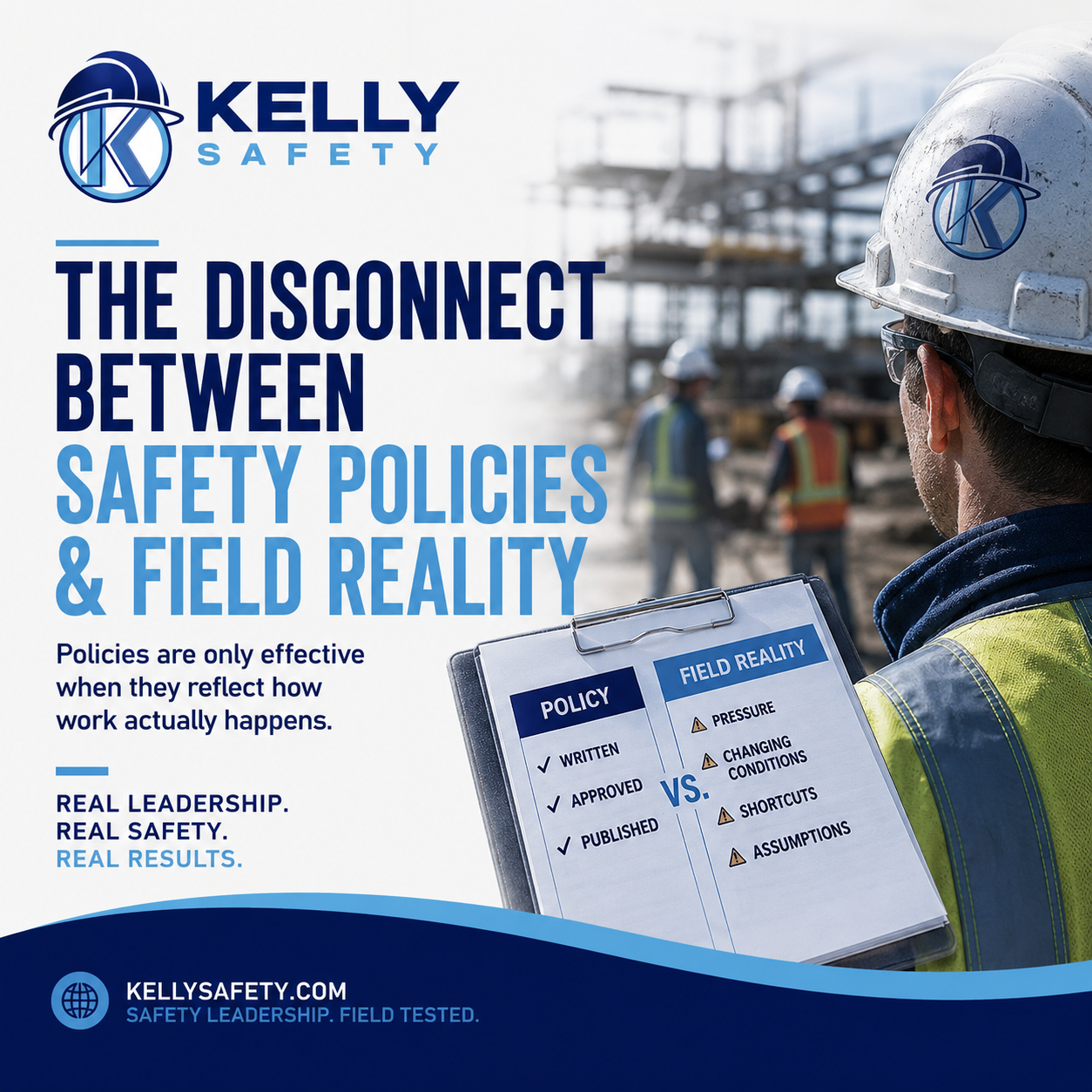
Safety policies are designed to reduce risk, but when they become disconnected from field reality, workers stop buying into them.
Most safety policies fail long before an incident happens
Most safety policies are written with good intentions. They are designed to create structure, reduce exposure, and establish clear expectations for how work should be performed. On paper, many of them look solid. The problem is that a policy can be technically correct and still fail completely in the field.
That failure usually starts when procedures are created without fully understanding how the work is actually performed. A process may look effective in a meeting room, but once it reaches an active jobsite with deadlines, changing conditions, equipment movement, and multiple crews operating at once, the gap between policy and reality becomes obvious very quickly.
Workers recognize that disconnect immediately. When a procedure feels unrealistic, inefficient, or disconnected from the actual task, crews begin working around it instead of with it. Once that happens, the policy may still exist on paper, but operationally, it has already failed.
Workers lose trust in safety systems that do not reflect the jobsite
One of the fastest ways to damage safety culture is to implement policies that workers know are not practical. Most experienced crews are not resisting safety itself. They are resisting systems that appear disconnected from the environment they work in every day.
This often happens when procedures are built entirely around compliance language without enough operational input. A worker performing maintenance during a shutdown, managing changing conditions around moving equipment, or coordinating with multiple contractors understands immediately whether a process reflects reality or not.
If the policy creates unnecessary obstacles without improving control of the work, workers stop seeing it as protection. They start seeing it as paperwork. Once that mindset develops, engagement drops, communication weakens, and crews become more likely to rely on habit and assumption instead of process.
The field changes faster than most procedures do
Construction, mining, and industrial environments are constantly evolving throughout the shift. Access points change, equipment moves, work areas overlap, and conditions develop in real time. The challenge is that many safety systems are static while the field itself is dynamic.
A procedure written weeks or months earlier may not fully account for what crews are dealing with at that moment. Workers then have to make operational decisions inside conditions the policy never anticipated. In many cases, that is where shortcuts begin to appear.
Not because workers are intentionally ignoring safety, but because they are trying to keep production moving inside an environment that no longer matches the process they were given.
Good crews will always choose operational reality over paperwork
When workers are forced to choose between completing the task and following a process they believe is unrealistic, operational reality usually wins. That is not a culture problem as much as it is a system design problem.
A crew managing an outage or shutdown does not have the luxury of treating every condition as static. They are adapting continuously to changing information, shifting priorities, and overlapping work. If safety systems are too rigid to function within that environment, workers will create their own methods to keep the work moving.
That is one of the biggest reasons strong safety programs are built with field involvement instead of being pushed down from a distance. The closer the process reflects actual operations, the more likely crews are to follow it consistently.
Policies written without field input usually create blind spots
One of the most common failures in safety management happens when procedures are developed without enough involvement from the people actually performing the work. Leadership may believe a policy solves a problem while the field immediately recognizes gaps that were never considered.
This is especially common around contractor work, shutdowns, maintenance activities, and multi-employer jobsites where conditions shift rapidly throughout the day. Workers see the operational conflicts first because they are the ones navigating them in real time.
Without that field-level perspective, policies often become too broad, too rigid, or too disconnected from the realities of production environments. Those blind spots create frustration, reduce buy-in, and weaken the overall effectiveness of the system.
Compliance alone does not create safety culture
According to the Occupational Safety and Health Administration, written safety programs and procedures are essential components of workplace safety systems. However, documentation alone does not create operational control.
Strong safety culture is built when workers believe procedures actually help them perform work more safely and efficiently. That level of trust only develops when leadership stays connected to field conditions and adjusts systems based on operational reality instead of assuming the paperwork tells the full story.
Crews are far more likely to follow a process they believe was built with an understanding of the work itself.
Leadership determines whether safety systems stay connected to reality
The strongest safety leaders are not the ones furthest removed from the field. They are the ones who stay close enough to operations to understand where pressure, exposure, and communication breakdowns are actually occurring.
That requires more than reviewing reports or checking documentation. It requires walking jobsites, talking with crews, observing how work is really being performed, and identifying where procedures no longer align with conditions in the field.
Leadership that remains operationally engaged builds systems that workers trust. Leadership that becomes disconnected from daily operations often creates systems workers simply learn to work around.
The best safety programs evolve with the work environment
No safety policy should be treated as untouchable. Conditions change, operations evolve, and lessons are learned through experience. The strongest programs are the ones that continuously improve based on feedback from the field.
That does not mean lowering standards or removing accountability. It means recognizing that operational environments are dynamic and safety systems have to evolve alongside them to remain effective.
Crews respect systems that improve because it shows leadership is paying attention to the realities of the work instead of protecting procedures for the sake of appearance.
A final thought from the field
Most workers can tell the difference between a safety system designed to help them and one designed simply to satisfy paperwork requirements.
The disconnect between policy and field reality is where many safety programs begin losing credibility. Once workers stop believing the process reflects the actual work environment, they stop relying on it when conditions become difficult.
The strongest safety cultures are not built through paperwork alone. They are built through leadership that stays connected to operations, listens to the field, and creates systems that function where the work is actually being performed.
That is what keeps safety from becoming a document and turns it into part of the operation itself.