
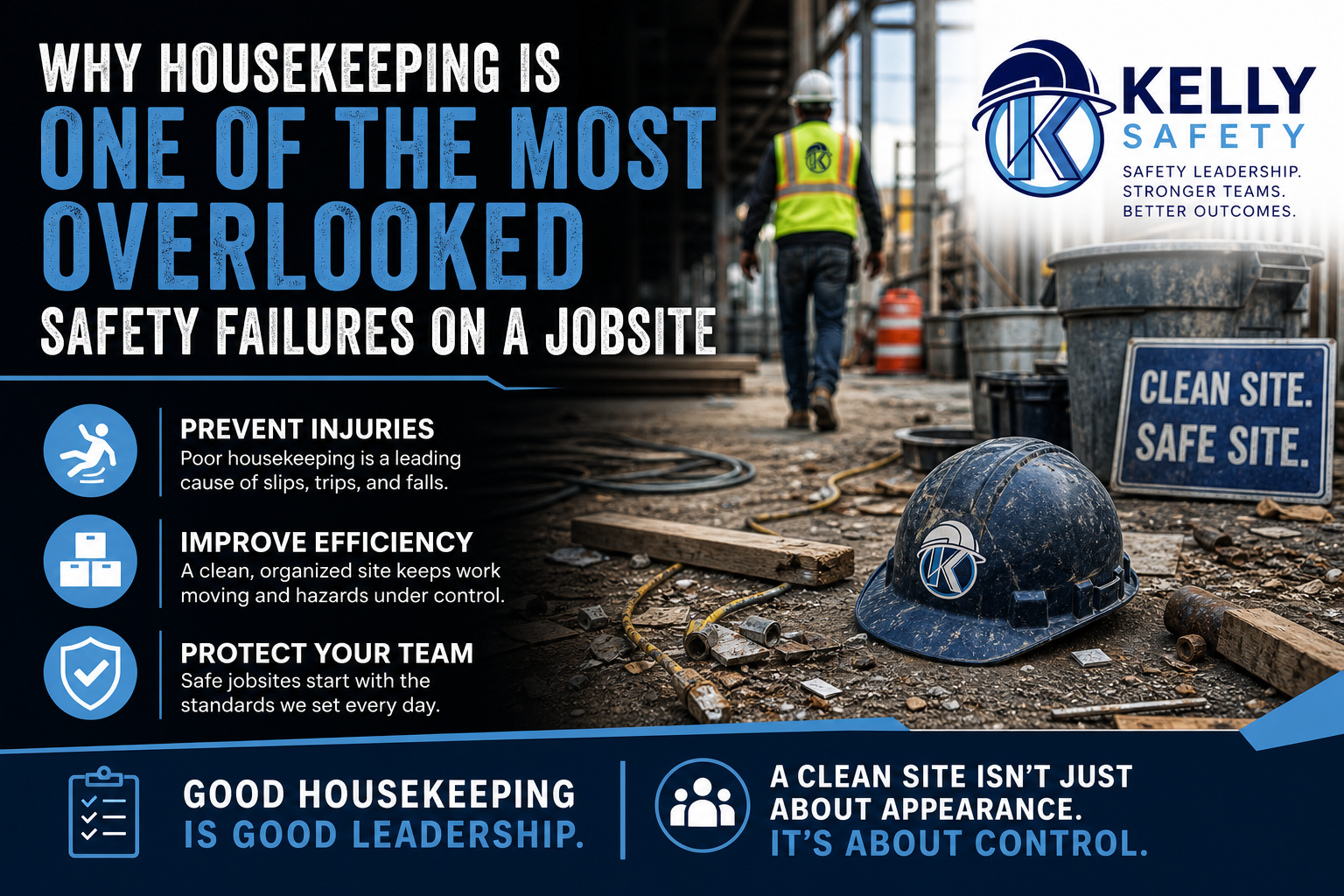
Why Housekeeping Is One of the Most Overlooked Safety Failures on a Jobsite
8–9 Minute Read
Housekeeping is often treated as a minor issue on jobsites, but it consistently contributes to real safety failures. As materials, tools, and debris accumulate, small oversights begin to create larger hazards that impact movement, visibility, and overall control of the work environment.
Housekeeping is often treated as a minor issue, but it drives real risk
On most jobsites, housekeeping is not viewed with the same level of urgency as other hazards. When people think about safety, they focus on falls, equipment, electrical exposure, or confined spaces. Those risks are visible and immediate, which is why they receive attention.
Housekeeping is different. It is often categorized as organization rather than safety, and because of that, it is underestimated. In practice, poor housekeeping creates conditions that increase exposure across the entire jobsite. Blocked access, scattered materials, and unmanaged debris all contribute to an environment where risk becomes more difficult to control.
Most housekeeping issues develop gradually and go unaddressed
Jobsite conditions rarely decline all at once. More often, they shift over time through a series of small decisions. Materials are set aside with the intention of being moved later. Tools are left in place because work is still in progress. Packaging and debris begin to accumulate in active work areas.
Individually, these decisions appear insignificant. Collectively, they change how the jobsite functions. Workers begin navigating around obstacles instead of removing them, and what was temporary becomes part of the work environment. That transition is subtle, which is why it often goes unrecognized until it creates a problem.
Slips, trips, and falls are strongly tied to housekeeping conditions
According to the Occupational Safety and Health Administration, slips, trips, and falls remain one of the leading causes of workplace injuries. Poor housekeeping is a consistent contributing factor, particularly in dynamic jobsite environments.
Cords running through access paths, uneven surfaces covered by debris, and materials left in walkways all increase the likelihood of an incident. Workers are typically focused on their task, not the ground beneath them. When housekeeping is not maintained, hazards are introduced into areas where movement is constant.
Material storage introduces risk that is often underestimated
Improper material storage is another area where housekeeping directly impacts safety. Materials that are stacked incorrectly, left unsecured, or placed in unstable positions create the potential for shifting or falling loads.
This is especially relevant on jobsites where materials are frequently moved and multiple crews are working in the same areas. Pallets stacked beyond safe limits, unsecured pipe or steel, and materials placed outside designated storage zones all contribute to unnecessary exposure. These conditions are often accepted as temporary, but the risk remains present as long as they exist.
Housekeeping breaks down during the exact moments it matters most
The periods when housekeeping is most critical are often the same periods when it receives the least attention. As activity increases and schedules tighten, focus shifts toward production. Cleanup is deferred, and hazards remain in place while work continues.
This is particularly evident during high-activity phases such as outages, shutdowns, or large-scale operations where multiple crews are working simultaneously. Increased movement combined with reduced housekeeping creates an environment where the margin for error becomes smaller.
Contractors are frequently exposed to conditions they did not create
On many jobsites, housekeeping is a shared responsibility, and contractors are often working in areas influenced by previous crews or other trades. This creates additional risk, as workers must navigate conditions that may not be clearly understood or controlled.
Without clear ownership and accountability, these conditions persist. A contractor may assume an area is acceptable because work is ongoing, even when underlying hazards are present. This is where breakdowns in coordination and oversight begin to affect safety outcomes.
Strong housekeeping reflects strong operational control
Well-managed jobsites treat housekeeping as part of maintaining control over the work environment, not as a secondary task. Clear access paths, organized materials, and defined storage areas improve both safety and efficiency.
When housekeeping is consistent, it reduces unnecessary movement, improves visibility, and allows hazards to be identified and addressed more effectively. It also creates a more structured environment for workers who are new to the site or unfamiliar with the layout.
High-performing crews address housekeeping as part of the work
The difference between average and high-performing crews is not awareness — it is consistency. Crews that perform well do not defer housekeeping to the end of the shift. They address it as part of the task itself.
Materials are cleared as work progresses, access paths remain open, and conditions are managed in real time. This approach prevents small issues from developing into larger problems and maintains a controlled environment throughout the workday.
Leadership determines whether standards are maintained
Housekeeping standards are ultimately defined by leadership. If cleanup is treated as optional or secondary, that expectation will be reflected across the jobsite. If it is enforced as part of doing the job correctly, it becomes part of the culture.
Workers respond to what is consistently reinforced. Leadership that remains present, addresses issues directly, and maintains expectations in real time creates a level of consistency that keeps conditions from deteriorating.
A final thought from the field
Housekeeping is one of the most controllable aspects of jobsite safety, yet it is often overlooked. It does not require complex systems or additional resources, but it does require attention and consistency.
Jobsites that maintain strong housekeeping do more than reduce risk. They operate more efficiently, improve coordination, and create an environment where workers can focus on the task without unnecessary obstacles.
At a leadership level, that consistency is not about appearance. It is about control, and control is what prevents incidents.