
The Hidden Risk of “Quick Jobs” on a Construction Site (And Why They Cause Injuries)
8–9 Minute Read
8–9 Minute Read
The Job That “Only Takes a Minute” Is Where Most Construction Injuries Start
If you’ve been on a construction site long enough, you know exactly how certain jobs get labeled. Nobody calls them high-risk. Nobody pulls out a plan. They get described in passing, just knocking something out, just making a quick adjustment, just fixing one small issue before moving on. Those are the jobs that don’t get attention because they don’t feel like they deserve it.
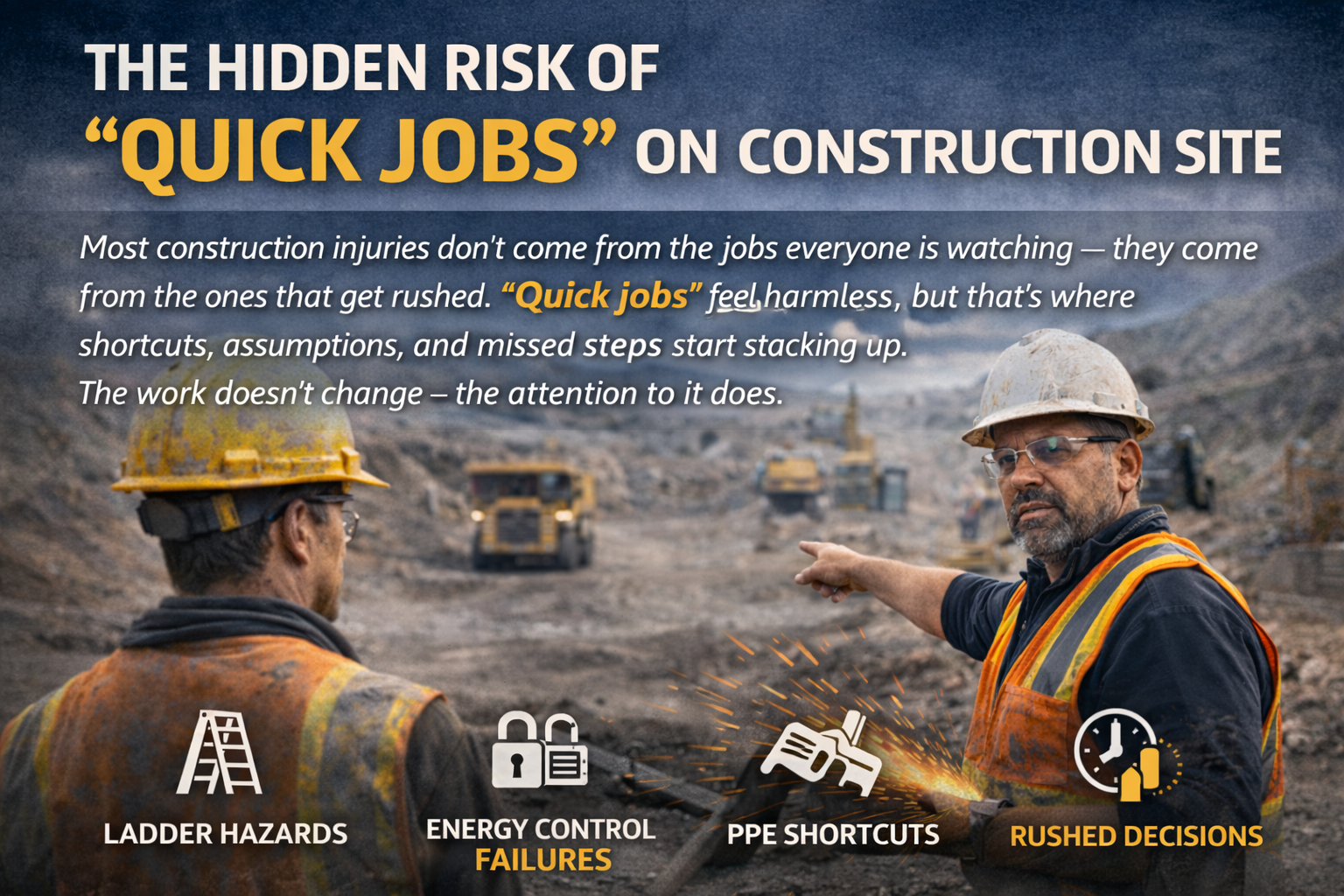
But across construction safety, those are the exact moments where incidents begin. Not during crane picks or major installations, but during the small tasks that fall between them. According to the Occupational Safety and Health Administration, a large portion of jobsite injuries happen during routine work, not complex operations. The issue isn’t a lack of knowledge. It’s a lack of attention when the job feels too small to matter.
When a Task Feels Routine, Hazard Awareness Drops Immediately
On a well-run jobsite, crews know how to respond when the work looks dangerous. You see it during steel erection, energized electrical work, or confined space entry. There’s communication, planning, and control because everyone understands what’s at stake.
But that same level of awareness disappears when the task looks simple. A worker sets up a ladder on gravel that hasn’t been leveled because it’s only being used for a quick reach. Someone climbs onto a piece of equipment instead of repositioning access because it’s faster. Another worker reaches into a panel or piece of machinery assuming it’s de-energized because production paused a few minutes earlier.
Nothing about those situations is unusual on a construction site. That’s exactly the problem. The hazard didn’t change — the attention to it did.
Most “Quick Jobs” Involve Real Exposure — Just Without the Planning
The majority of small tasks still involve the same hazards found in larger operations. Working at height, stored energy, pinch points, sharp edges, and moving equipment don’t disappear just because the job is short.
You see it when a worker climbs a ladder to adjust ductwork without securing it properly, standing off-center to reach instead of repositioning. You see it when someone clears a jam on a conveyor or auger without full lockout because it “shouldn’t move.” You see it when a worker removes gloves to handle material more easily and exposes their hands to cuts or crush points.
These are normal construction site scenarios. They happen every day. And because they happen every day without incident, they start to feel safe even when they’re not.
Speed Creates Assumptions & Assumptions Create Risk
Time pressure on a jobsite doesn’t always come from management. Most of it is internal. Crews want to stay productive, stay ahead, and keep the job moving. That’s where quick jobs become dangerous, they feel like opportunities to save time.
Instead of verifying conditions, workers assume. Instead of checking isolation, they trust that it’s already been handled. Instead of setting up properly, they take the fastest option available.
That’s the shift that matters. The job doesn’t become more dangerous; the margin for error just gets smaller. And once assumptions replace verification, the outcome depends on luck instead of control.
Energy Control Failures Happen During “Small Adjustments,” Not Big Jobs
One of the most overlooked risks in construction safety shows up during minor equipment interaction. A worker makes a quick adjustment, clears a blockage, or checks alignment without applying full lockout/tagout because the task doesn’t feel significant.
But data from the National Institute for Occupational Safety and Health continues to show that improper energy isolation is a leading cause of serious injuries. And those failures rarely happen during scheduled maintenance; they happen during moments where someone assumes the system is safe.
That’s the difference between a controlled job and an exposed one. Not the task itself, but whether the hazard was verified or assumed.
The Body Doesn’t Recognize “Quick Work”
There’s a misconception across construction that shorter tasks carry less risk. But exposure doesn’t work on a timeline. A fall from a ladder doesn’t change because the task was supposed to take thirty seconds. A rotating component doesn’t become less dangerous because someone is only reaching in for a moment.
The human body doesn’t measure intent or duration. It reacts to conditions. And when those conditions are wrong, the outcome is the same; regardless of how small the job felt at the time.
That’s why so many incidents come from work that was never treated like it needed control.
Professional Crews Apply the Same Standards to Every Task
The difference between crews that struggle with incidents and crews that don’t comes down to consistency. The best contractors don’t separate work into “big jobs” and “quick jobs” when it comes to safety.
They take the time to stabilize ladders and reposition access instead of overreaching. They verify lockout/tagout every time equipment is touched, not just during planned shutdowns. They wear PPE because it’s part of the job, not because the task looks dangerous.
That consistency removes decision-making in the moment. It replaces shortcuts with habits. And on a construction site, habits are what determine outcomes.
Small Shortcuts Quietly Become Jobsite Culture
On any construction site, behavior spreads faster than policy. One shortcut doesn’t seem like a big deal, especially when nothing goes wrong. But once it’s seen, it gets repeated. Then it becomes expected.
A new worker watches how experienced workers handle quick tasks and assumes that’s the standard. Over time, those small decisions stack into a system that was never intentionally built.
That’s how risk becomes part of the job; not through bad intent, but through repetition.
Leadership Is Defined in the Jobs Nobody Is Watching
It’s easy to enforce safety when the task is obviously dangerous. When the risk is visible, people naturally pay attention. But real leadership shows up during the moments that don’t look critical.
It’s in correcting the ladder setup before someone climbs it. It’s in stopping a quick adjustment to verify energy isolation. It’s in making it clear that standards don’t change based on how long a task takes.
That’s what crews respond to. Not policies, not meetings but what actually gets enforced in real time.
If you’re serious about building that kind of consistency across your crews, this is exactly where structured training and oversight start to matter:
🔗 www.kellysafety.com/promo
A Final Thought From the Field
The most dangerous work on a construction site isn’t always the biggest or the most complex. It’s the work that doesn’t get treated like it matters.
The job that only takes a minute.
The adjustment that feels routine.
The shortcut that seems harmless in the moment.
That’s where incidents live.
Because construction safety isn’t about how difficult the job is. It’s about how consistently the work is done. And the crews that understand that aren’t just safer; they operate at a completely different level.