
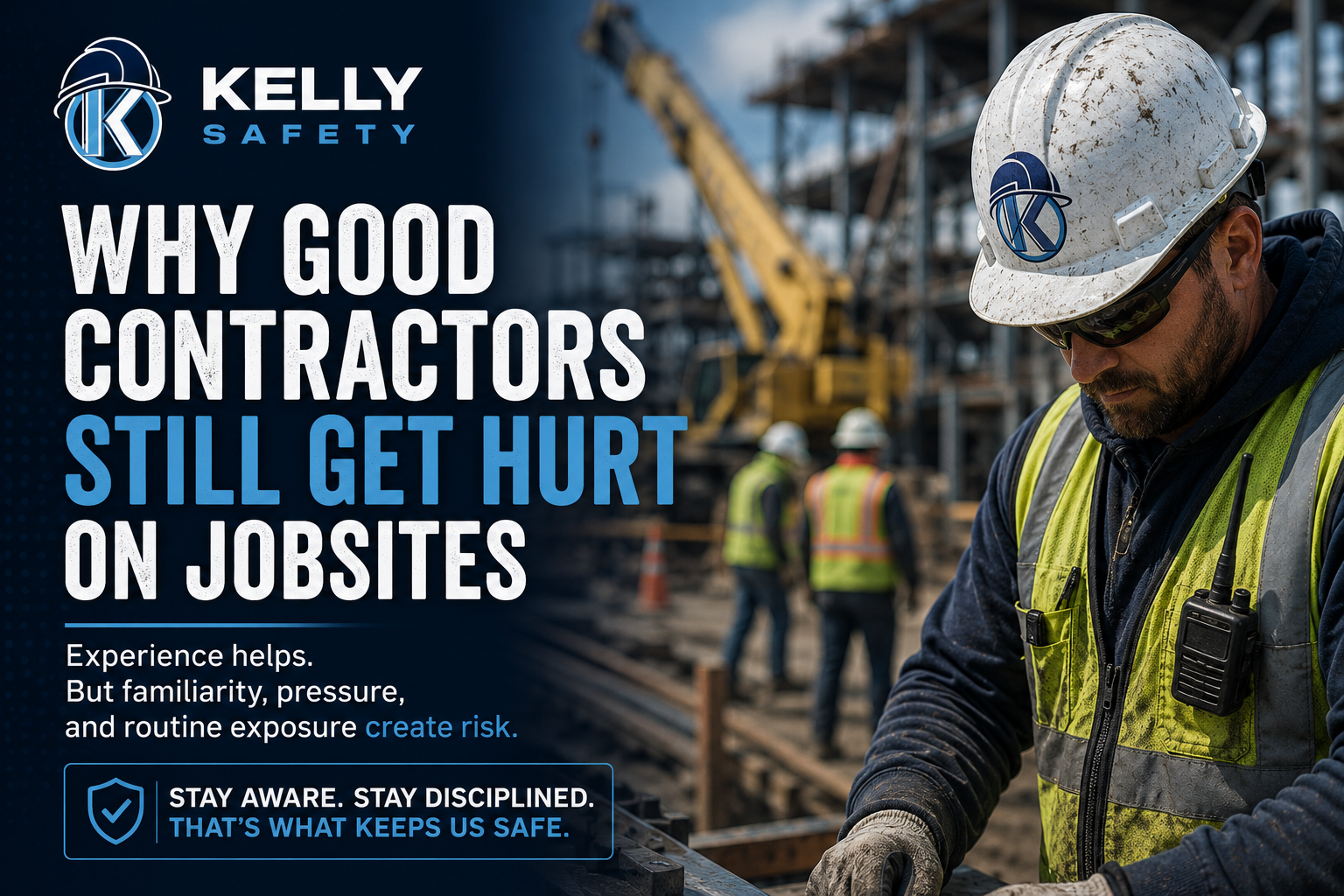
Why Good Contractors Still Get Hurt on Jobsites
8–9 Minute Read
Experience alone does not prevent incidents on jobsites. Learn why skilled contractors still get hurt and how familiarity, pressure, and routine exposure create risk in construction and industrial work.
Experience reduces mistakes, but it can also reduce awareness
One of the biggest misconceptions in construction and industrial work is that experience alone prevents incidents. Strong contractors know their trade, understand equipment, and have spent years working in difficult environments. That experience matters, but it does not eliminate exposure.
In many cases, experienced workers become more vulnerable to certain hazards because the work no longer feels unfamiliar. Tasks become routine, environments become familiar, and the level of caution that naturally exists during newer work starts to decline over time. The risk is not usually a lack of knowledge. It is the gradual normalization of exposure.
That is why some of the most respected and capable workers on a jobsite still end up getting hurt.
Familiarity changes how hazards are perceived
Workers entering a new environment tend to move slower, observe more carefully, and verify conditions before starting work. Experienced contractors often operate differently because they have performed the same types of tasks hundreds or thousands of times before.
That familiarity increases confidence, but it can also create blind spots.
A worker who has climbed ladders daily for years may stop noticing small setup issues. Someone who routinely works around mobile equipment may become comfortable operating close to active travel paths. A contractor performing maintenance work during shutdowns may begin relying on assumptions instead of verification because similar tasks have gone smoothly in the past.
The environment has not become safer. The worker has simply become more comfortable inside it.
Most incidents develop during routine work, not unusual situations
According to the Occupational Safety and Health Administration, many workplace injuries occur during routine activities that workers perform regularly. These incidents are often tied to moments where attention decreases because the task itself no longer feels high-risk.
This is one of the reasons routine work deserves as much attention as complex operations. The longer workers perform a task without incident, the easier it becomes to believe the exposure is fully controlled. Over time, small shortcuts begin to appear, verification decreases, and workers start operating from expectation instead of observation.
That shift is usually gradual enough that crews do not recognize it happening in real time.
Pressure changes behavior even among highly skilled workers
Experienced contractors are often the workers relied on most during difficult phases of work. They are expected to solve problems quickly, keep production moving, and handle situations newer workers may not be comfortable managing.
That pressure affects decision-making.
When schedules tighten or operational demands increase, even strong crews begin looking for efficiency. Steps that normally receive full attention can start feeling repetitive or unnecessary. Communication shortens, assumptions replace confirmation, and workers begin relying more heavily on experience to navigate conditions quickly.
The issue is not capability. In many cases, it is overconfidence in the belief that experience alone is enough to maintain control.
Good contractors often take on the highest exposure
On most jobsites, experienced workers are trusted with the most demanding tasks. They are assigned difficult maintenance work, complex troubleshooting, confined space entries, shutdown activities, and high-risk operational responsibilities because leadership believes they can manage the exposure.
In many situations, that trust is earned.
However, increased responsibility also increases exposure frequency. The contractors most capable of handling risk are often the ones placed in hazardous environments most often. Over time, repeated exposure can create a false sense of predictability where workers begin expecting conditions to behave the same way they always have before.
That is where incidents begin catching experienced crews off guard.
Situational awareness declines when workers operate on routine
One of the most dangerous moments on a jobsite is when work becomes automatic. Contractors who operate heavily from routine may begin focusing more on task completion than environmental changes happening around them.
Conditions on construction and industrial sites change constantly throughout the day. Equipment movement shifts, access paths change, new crews enter work areas, and surrounding hazards evolve continuously. Workers who stop actively reassessing those conditions become more vulnerable to exposure, even when they are technically performing the task correctly.
Situational awareness is not replaced by experience. If anything, experience requires stronger awareness to prevent routine from taking over decision-making.
Strong safety culture protects experienced workers too
One of the biggest mistakes leadership can make is assuming experienced workers require less oversight or reinforcement. Strong contractors still benefit from accountability, communication, and operational controls.
The best safety cultures are built around consistency, not assumptions about skill level. Verification processes, pre-task planning, communication standards, and field leadership all exist to prevent familiarity from quietly reducing attention over time.
When safety systems are only emphasized around newer workers, experienced crews are more likely to operate independently from the process. That separation weakens consistency across the jobsite.
Leadership has to prevent confidence from becoming complacency
There is a difference between confidence and complacency, but the line separating them is often small. Confidence comes from experience and preparation. Complacency develops when workers begin believing nothing unexpected will happen because it has not happened before.
Leadership plays a major role in preventing that transition.
Supervisors who stay engaged with experienced crews, ask questions, verify conditions, and reinforce standards consistently help prevent routine exposure from becoming normalized. This is not about questioning capability. It is about maintaining awareness inside environments where risk is constantly changing.
The strongest leaders understand that experienced workers are still human, and human behavior naturally adapts to familiarity over time.
A final thought from the field
Good contractors still get hurt because experience does not remove exposure. In many cases, it increases the likelihood that workers become comfortable inside environments that still contain serious hazards.
The strongest crews are not the ones who rely entirely on experience. They are the ones who continue slowing down, verifying conditions, and reassessing the environment no matter how familiar the work becomes.
That level of discipline is what separates experience from complacency and helps keep skilled workers from becoming part of the incident they never expected to happen.