
The Most Common OSHA Safety Violations Contractors Get Cited For
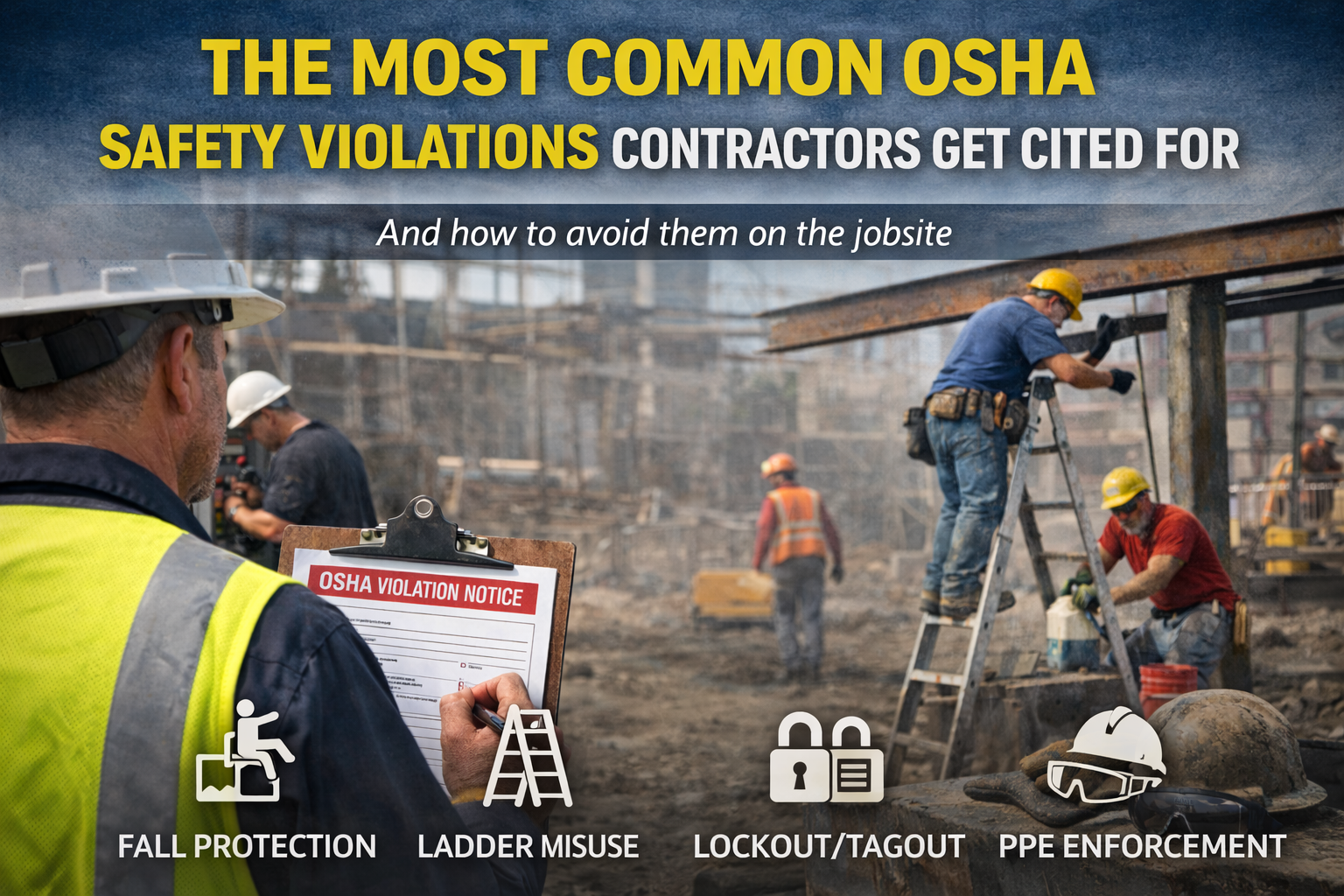
Most OSHA citations don’t come from complicated safety failures they come from the same preventable mistakes. Here are the most common violations contractors face and how to avoid them.
8–9 Minute Read
Why Contractors Keep Getting Cited
If you’ve been around jobsites long enough, you’ve probably heard someone say, “OSHA only shows up when something bad happens.”
That’s not really true.
Most inspections happen because something caught someone’s attention; a complaint, a visible hazard, or sometimes just being in the wrong place at the wrong time. When an inspector walks onto a jobsite, they’re not looking for creative violations. They’re looking for the basics.
And the reality is this: contractors rarely get cited for complicated problems. They get cited for things everyone already knows they should be doing. The same handful of safety issues show up on OSHA’s most cited violations list year after year. Not because the rules are confusing but because people get comfortable, rush work, or assume nothing will happen.
Understanding where contractors usually slip up is one of the easiest ways to avoid becoming another citation statistic.
Fall Protection: The Violation That Never Leaves #1
Every year, fall protection sits at the top of OSHA’s violation list.
Not second. Not third. First.
Falls are one of the leading causes of death in construction, and most of them happen from heights that people underestimate; rooftops, scaffolds, ladders, mezzanines, and elevated work platforms. The common problem isn’t that contractors don’t know about fall protection. It’s that they start treating exposure like it’s temporary.
Someone climbs up “just for a second.” A harness stays in the truck. Guardrails are planned but never installed.
The dangerous part is how normal this behavior can start to feel when nothing bad happens for a while.
Professional crews understand something important: the moment you normalize working unprotected at height, the clock starts ticking.
Ladder Misuse and Improvised Access
If there’s one tool on every jobsite that people underestimate, it’s the ladder. Ladders are simple. Familiar. Easy to grab and move around. That familiarity is exactly what causes problems. Contractors often use ladders for things they were never designed for reaching too far, standing on the top rung, setting them up on uneven ground, or using them as makeshift scaffolding.
The issue usually isn’t the ladder itself. It’s the mindset that the job will only take a minute.
Most ladder injuries happen during quick tasks where someone skipped proper setup because they thought the risk was small. Unfortunately, gravity doesn’t care whether a job takes thirty seconds or thirty minutes.
Lockout/Tagout Failures During Maintenance Work
Lockout/tagout violations often show up during contractor work inside industrial facilities. Maintenance jobs, shutdowns, and repair work frequently require contractors to interact with equipment they don’t normally operate. When energy sources aren’t properly isolated, workers can be exposed to electrical, mechanical, hydraulic, or pneumatic hazards.
What makes this violation common is the confusion between host employer procedures and contractor responsibilities. Someone assumes the equipment is already locked out. Someone else assumes another crew handled the isolation. When responsibilities aren’t clearly communicated, workers end up relying on assumptions instead of verified energy control. And assumptions are where incidents happen.
Hazard Communication Breakdowns
Another violation that appears consistently on OSHA citation lists involves hazard communication; specifically chemical safety.
Most contractors think of hazard communication as something that applies mainly to chemical plants or manufacturing facilities. In reality, it shows up on everyday jobsites through common materials like solvents, adhesives, coatings, fuels, and cleaning agents. The requirements themselves aren’t complicated: Workers need to understand what chemicals they’re exposed to, how to handle them safely, and where to find safety data sheets.
Where contractors run into trouble is when products get introduced onto a jobsite without communication. Someone brings in a new chemical. Another crew starts using it. Nobody explains the hazards.
What starts as a small oversight can turn into a compliance problem very quickly.
PPE Is Only Effective If It’s Actually Used
Personal protective equipment is one of the most visible parts of jobsite safety, which makes it surprising how often PPE violations still happen.
Hard hats sitting on truck dashboards.
Safety glasses pushed up onto foreheads.
Gloves left off during quick tasks.
On paper, most companies have PPE policies. The difference between a rule and a safety culture is whether those rules are actually enforced. When supervisors ignore PPE violations, the message becomes clear; the equipment is optional. And once something becomes optional on a jobsite, it usually disappears.
The Pattern Behind Most Safety Violations
After years working around contractors, one thing becomes obvious. Most safety violations don’t happen because workers are reckless. They happen because people are trying to move faster.
Deadlines get tight.
Crews want to finish a task before lunch.
Someone thinks they can save five minutes by skipping a step.
Safety shortcuts rarely feel dramatic in the moment. They usually feel small, practical, and temporary. But when those shortcuts become routine, they create the exact conditions that inspectors and accidents are looking for.
What Smart Contractors Do Differently
The contractors who avoid citations usually aren’t the ones with the thickest safety manuals. They’re the ones who build habits around the basics. They slow down long enough to set up ladders correctly. They enforce fall protection even when the task seems quick. They make sure workers understand chemicals and energy hazards before the work begins. More importantly, they treat safety as part of professionalism; not as something that only matters when an inspector shows up.
That mindset changes everything.
When workers believe safety is part of doing the job right, compliance takes care of itself.
A Final Thought From the Field
If you look at OSHA’s most cited violations every year, the list rarely changes.
Fall protection.
Ladders.
Lockout/tagout.
Hazard communication.
PPE.
These aren’t obscure rules hidden in regulatory manuals. They’re the fundamentals of protecting workers. The good news is that avoiding these violations doesn’t require complicated systems or expensive programs. It requires leadership, training, and the willingness to slow down long enough to do things the right way. Because at the end of the day, safety citations are more than paperwork. They’re warning signs that something on the jobsite needs attention before someone gets hurt.