
What Is Safety? A Question the Industry Still Gets Wrong
Read Time: 9–10 minutes
What Is Safety? Moving Beyond Compliance in High-Risk Industries
What Safety Really Means: Leadership, Culture, and Daily Decisions. Defining Safety in Construction and Mining: More Than Compliance
Read Time: 9–10 minutes
Ask ten people in our industry what safety is and you’ll get ten different answers. Some will point to policies and procedures. Others will talk about OSHA, training records, inspections, and PPE. All of those things matter, but none of them truly answer the question. After years in the field, in leadership roles, and working alongside contractors and crews in high-risk environments, I have come to believe that most companies are participating in safety without ever defining what it actually means. We measure it, track it, and talk about it constantly, yet we rarely stop and ask whether the systems we’ve built are changing behavior or simply producing documentation.
One of the most common misconceptions is the belief that compliance and safety are the same thing. Compliance is measurable and necessary, but it is only the foundation. It exists to establish minimum expectations, not to define excellence. A company can meet every regulatory requirement and still operate in a way that exposes workers to unnecessary risk. Passing an audit does not guarantee that the work is being performed safely; it only proves that certain elements are in place. Real safety shows up in the moment a worker pauses because something does not look right, when a supervisor slows production to correct a hazard, or when a crew refuses to take a shortcut even though no one would have noticed.
This is why safety cannot belong to a single department or a single individual. Too often, responsibility is placed on the safety manager as though the presence of that role alone creates a safe operation. In reality, safety is shaped by leadership decisions long before a safety professional ever steps onto a jobsite. It is defined by how work is planned, how schedules are built, how supervisors are trained, and how expectations are communicated. Every worker knows what the true priorities are, not because of what is written in a policy, but because of what happens when production and protection come into conflict. Safety is not what leadership says during a meeting; it is what leadership reinforces when the pressure is highest.
Strong safety cultures are never personality-driven. They are system-driven. When safety depends on one person’s energy or presence, it becomes inconsistent and fragile. When it is embedded into planning, communication, and daily operations, it becomes sustainable. The safest organizations I have seen are not the ones that talk about safety the most, but the ones where the expectations are clear, consistent, and supported at every level. New hires understand them from day one, experienced workers model them without being asked, and supervisors reinforce them without hesitation.
Trust plays a role that cannot be overstated. Workers do not follow procedures because they were told to; they follow them because they believe the company genuinely values their well-being. That belief is built over time through action. It is built when hazards are corrected quickly, when concerns are taken seriously, and when stopping a job is treated as professionalism rather than disruption. In environments where trust exists, safety becomes a shared responsibility. Crews look out for each other, and accountability is no longer something imposed from above but something that lives within the team.
Another reality the industry struggles with is the tendency to treat safety as an event rather than a daily practice. Annual training sessions, quarterly stand-downs, and post-incident meetings all have their place, but they do not define the culture. Safety is created in the ordinary moments that never appear in reports: the decision to walk back and get the right PPE, the extra time taken to properly isolate energy, the conversation with a new worker to explain not just what to do but why it matters. These small, repetitive actions shape how work is performed far more than any formal program.
At its core, safety is a reflection of respect. It is respect for the people doing the work, for the skill required to perform it, and for the reality that every individual on a jobsite has a life beyond it. When safety is real, workers feel it in how they are treated, in how problems are handled, and in whether their experience and input are valued. When it is performative, they recognize that as well. No amount of documentation can compensate for a lack of genuine respect.
Low incident rates are often used as the primary indicator of success, but numbers alone rarely tell the full story. They can reflect experienced crews, favorable conditions, or short project durations just as easily as they reflect strong systems. Real safety is visible in planning, in communication, and in how quickly issues are identified and corrected before they escalate. It is present in the consistency of expectations, not in the absence of recorded injuries.
This matters because of the nature of the industries we serve. Construction, mining, and industrial work are built on a culture of problem-solving, resilience, and productivity under pressure. Those qualities are what make these fields successful, but they also create risk when they are not balanced with disciplined planning and execution. Safety asks professionals to do something that runs against instinct in high-production environments: to slow down, to reassess, and to choose the long-term outcome over the short-term gain. That is not weakness; it is the highest form of professionalism.
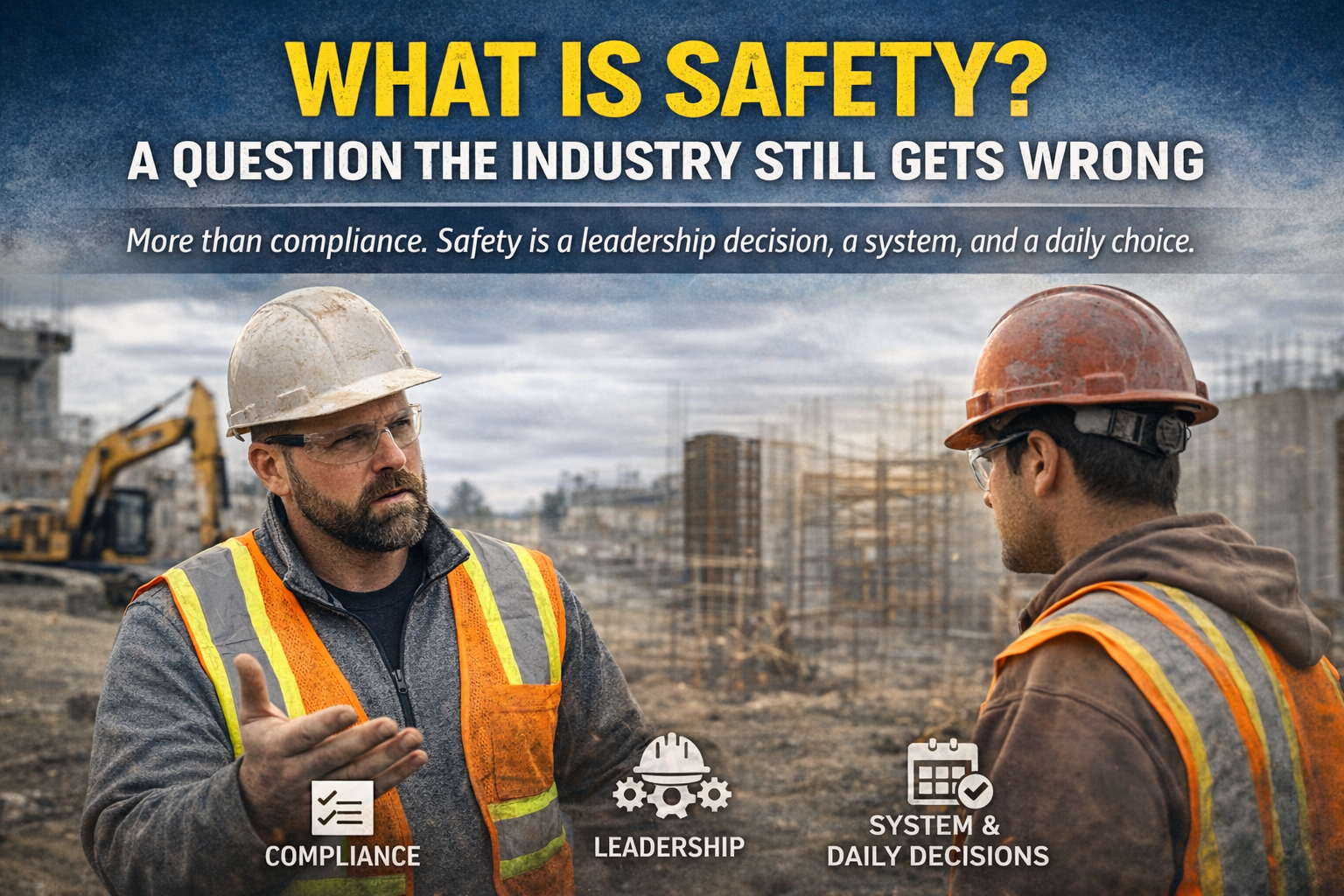
So the question remains: what is safety? It is not a manual, a checklist, or a certification. It is a leadership decision that becomes a system and is reinforced through daily behavior. It is the difference between reacting to incidents and preventing them, between saying that people matter and structuring work in a way that proves it. It is not something that exists separately from operations; it is the way operations are conducted.
If we are honest with ourselves, our industry still has work to do in making that distinction clear. Because safety is not about avoiding penalties or meeting minimum standards. It is about ensuring that the people who build our infrastructure, extract our resources, and keep our facilities running return home in the same condition they arrived.
Every single day.