
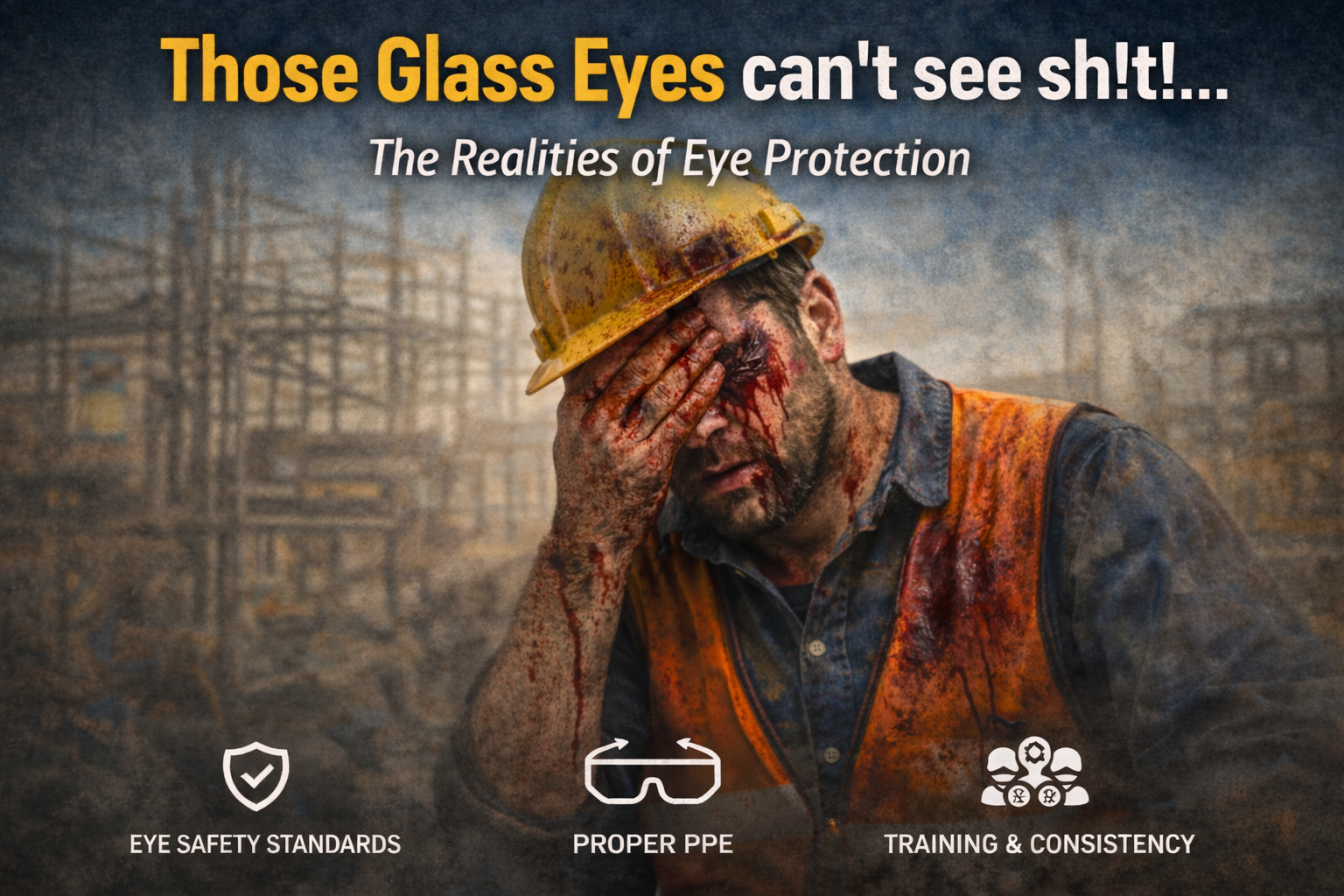
“Those Glass Eyes can’t see sh!t!…”:The Realities of Eye Protection
Read Time: 7–8 minutes
Eye injuries are some of the most common and most underestimated, injuries on a jobsite. I’ve watched workers shake off close calls like they were nothing: sparks in the face, dust clouds, flying chips, chemical splashes that barely missed. Too often, people treat their eyes like they’re tougher than the rest of their body. They’re not.
This post is dedicated to my late Uncle Mike one of the hardest-working, self-made men I’ve ever known. His wisdom, grit, and no-nonsense teachings didn’t just shape; they built a foundation that has carried through generations.
Eye injuries are some of the most common and most underestimated, injuries on a jobsite. I’ve watched workers shake off close calls like they were nothing: sparks in the face, dust clouds, flying chips, chemical splashes that barely missed. Too often, people treat their eyes like they’re tougher than the rest of their body. They’re not.
As President of Kelly Safety, I’ve seen what happens when eye protection is ignored. I’ve also seen what happens when it’s taken seriously. One path leads to ER visits, lost workdays, and careers changed forever. The other leads to workers going home with the same vision they showed up with and that’s a win every single time.
Why Eye Injuries Happen So Often
Most eye injuries don’t come from dramatic accidents. They come from routine work: grinding, cutting, drilling, sweeping, welding, mixing chemicals, or even walking through an active work zone. People get comfortable. They lift their glasses “just for a second.” They forget to put them back on after lunch. They assume the task is low risk.
OSHA reports that thousands of workers suffer eye injuries each year, many of which could have been prevented with proper eye and face protection. Their guidance makes it clear that eye hazards exist in construction, mining, manufacturing, maintenance, and even light industrial work.
https://www.osha.gov/laws-regs/regulations/standardnumber/1910/1910.133
What gets people hurt isn’t usually ignorance, it’s familiarity. When you do the same task every day, the danger fades into the background. But the hazard doesn’t disappear just because you’re used to it.
What Eye Injuries Really Cost
An eye injury isn’t just a medical issue. It’s a business issue, a family issue, and often a life-changing issue.
NIOSH points out that eye injuries can lead to partial or total vision loss, long-term disability, and permanent changes to how a person works and lives.
https://www.cdc.gov/niosh/topics/eye
Beyond the human cost, companies face downtime, workers’ comp claims, investigations, and damaged trust. One “minor” incident can ripple through an entire crew, especially when everyone realizes how close it came to being permanent.
I’ve never met a worker who said, “I wish I hadn’t worn my safety glasses.” But I’ve met plenty who wish they had.
Not All Eye Protection Is the Same
One of the biggest mistakes I see is assuming all safety glasses offer the same protection. They don’t.
Different tasks require different protection:
Grinding and cutting often require impact-rated glasses with side shields or goggles
Welding requires proper filtered lenses and face shields
Chemical handling may require sealed goggles and face protection
Dusty environments often need wraparound protection
OSHA and the American National Standards Institute (ANSI) require eye protection to meet specific impact and design standards.
https://www.osha.gov/sites/default/files/publications/osha3151.pdf
If PPE isn’t matched to the hazard, it creates a false sense of security—and that’s just as dangerous as wearing nothing at all.
Why Workers Skip Eye Protection
Most workers don’t skip PPE because they don’t care. They skip it because:
It’s uncomfortable
It fogs up
It doesn’t fit right
It slows them down
Nobody enforces it consistently
That last one matters most. When supervisors ignore eye protection, workers do too. When leadership enforces it every time, it becomes normal.
The National Safety Council consistently emphasizes that PPE compliance is driven more by culture than by rules.
https://www.nsc.org/workplace
If the culture says eye protection matters, people wear it—even when it’s inconvenient.
Training Makes PPE Make Sense
Eye protection works best when people understand why they’re wearing it. That’s where training comes in. Workers who understand how eye injuries happen, what permanent damage looks like, and how easily accidents occur take PPE more seriously.
OSHA continues to stress that PPE must be part of a broader safety training system, not just handed out without explanation.
https://www.osha.gov/training
This is why many contractors use ongoing training systems like our Training Subscription at
https://www.kellysafety.com/subscription
so workers get consistent refreshers instead of one-time lectures that fade fast.
Training builds knowledge. Repetition builds habits.
Eye Protection Is a Leadership Issue
I’ve said it for years: safety starts with leadership. Eye protection is no different. When supervisors wear their PPE, crews follow. When leadership ignores it, so does everyone else.
A strong safety program doesn’t argue about eye protection. It normalizes it. It plans for it. It enforces it calmly and consistently. That’s one reason contractors turn to our Safety Management Membership at
https://www.kellysafety.com/membership to help build systems that support supervisors instead of leaving them to fight these battles alone.
Consistency is what changes behavior.
Why This Matters to Me
I’ve seen people lose vision from one careless moment. I’ve seen careers end because someone thought, “It’ll be fine this time.” And I’ve seen the guilt that stays with crews who watched it happen.
Eyes don’t heal like a cut hand or a sore back. Some damage is forever. That’s why I push this so hard.
Eye protection isn’t about looking professional. It’s about making sure the person who shows up tomorrow is the same person who leaves today.
Conclusion: Vision Is Worth Protecting Every Day
Eye protection is one of the simplest safety measures we have and one of the most ignored. The tools are there. The standards are clear. The injuries are preventable.
What makes the difference is culture, leadership, and systems that support workers instead of relying on memory and luck. If you want eye protection to be taken seriously on your jobsites, it has to be part of how you operate not something you remind people about only after a close call. That’s what strong safety programs do. They protect workers before something goes wrong.
And at Kelly Safety, that’s the standard we help contractors build, every single day.