
HAZWOPER Training: Why Hazardous Waste Safety Can’t Be Treated as One-and-Done
Read Time: 7–8 minutes
HAZWOPER is one of those words that immediately gets a reaction. For some, it means paperwork and refresher deadlines. For others, it means serious work in serious environments, chemical exposure, unknown hazards, emergency response, and situations where mistakes don’t come with second chances.
Read Time: 7–8 minutes
HAZWOPER is one of those words that immediately gets a reaction. For some, it means paperwork and refresher deadlines. For others, it means serious work in serious environments, chemical exposure, unknown hazards, emergency response, and situations where mistakes don’t come with second chances.
As President of Kelly Safety, I’ve spent time around sites where HAZWOPER training was treated like a checkbox, and others where it was treated like a lifeline. The difference between those two approaches is measured in injuries avoided, exposures prevented, and people who get to go home healthy at the end of the day.
Hazardous waste operations don’t forgive shortcuts. And HAZWOPER training shouldn’t either.
Why HAZWOPER Exists in the First Place
HAZWOPER wasn’t created to complicate work; it was created because people were getting hurt, sick, and killed while handling hazardous substances without proper controls. OSHA’s HAZWOPER standard was designed to protect workers involved in hazardous waste cleanup, emergency response, and treatment, storage, and disposal operations.
https://www.osha.gov/laws-regs/regulations/standardnumber/1910/1910.120
These environments are unpredictable by nature. Chemicals react differently under different conditions. Containers fail. Labels fade. Air quality changes. The risk isn’t always visible, and that’s exactly what makes this work so dangerous.
Training is the first layer of protection but only if it’s taken seriously.
Why One-Time HAZWOPER Training Falls Short
HAZWOPER training is often approached as a compliance milestone: take the course, print the certificate, move on. The problem is that hazardous waste environments don’t stay static. New materials are introduced. Processes change. Emergency response plans evolve. Workers rotate in and out. When training stops at certification, knowledge fades—and that’s when exposure risks increase.
NIOSH research consistently shows that workers exposed to hazardous substances face increased risk when training and hazard communication aren’t reinforced over time.
https://www.cdc.gov/niosh/topics/emres
Training provides awareness. Ongoing safety management provides protection.
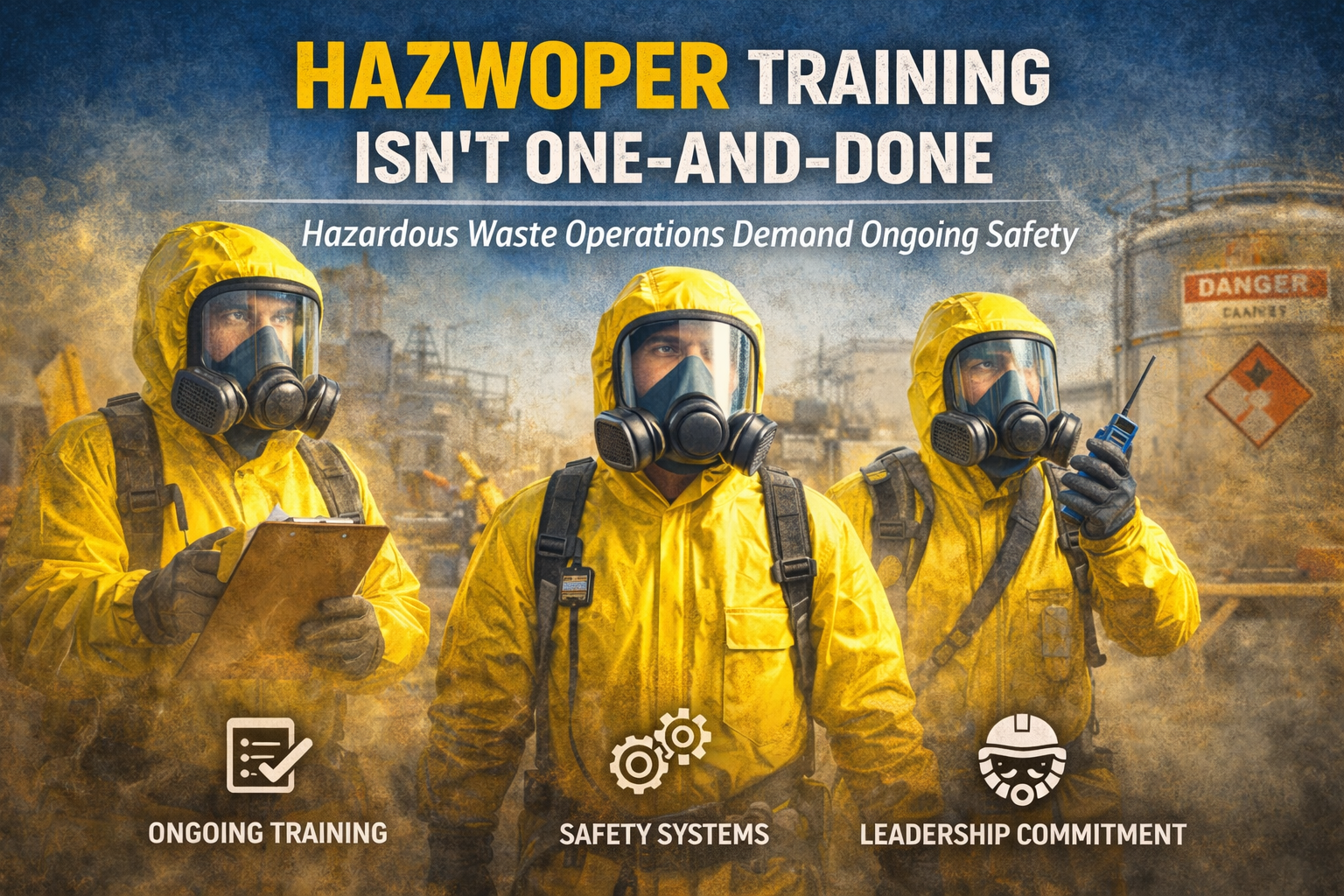
HAZWOPER Is a System, Not a Course
The most effective HAZWOPER programs I’ve seen treat training as one part of a broader system. That system includes site-specific hazard analysis, clear communication, documented procedures, medical surveillance, and leadership oversight.
OSHA makes it clear that HAZWOPER compliance involves more than training hours; it includes emergency response planning, PPE selection, exposure monitoring, and supervision.
https://www.osha.gov/SLTC/hazardouswaste
When companies focus only on training hours, they miss the bigger picture. When they focus on systems, workers stay safer.
Where Safety Breaks Down in Hazardous Work
Most failures don’t come from lack of intelligence or effort. They come from pressure. Tight schedules. Production demands. Fatigue. Familiarity. Workers begin to rely on experience instead of procedure. Supervisors assume everyone remembers the protocol. Small deviations stack up until something goes wrong.
This is where ongoing safety support matters. When safety systems reinforce expectations consistently, workers don’t have to rely on memory alone.
That’s exactly why many contractors use the Kelly Safety Membership to support hazardous work environments. It provides structure, documentation support, and guidance that doesn’t disappear after the initial training is complete.
https://www.kellysafety.com/membership
Emergency Response Is Where Training Is Tested
HAZWOPER training shows its real value when something goes wrong. Spills, releases, unexpected reactions, these moments don’t allow time to “figure it out.”
The Environmental Protection Agency emphasizes that emergency response effectiveness depends heavily on preparedness and training that is current and site-specific.
https://www.epa.gov/emergency-response
When workers aren’t confident in their training, hesitation creeps in. When they are confident, response is faster, calmer, and safer. That confidence doesn’t come from a single class. It comes from repetition, refreshers, and leadership reinforcement.
What Strong HAZWOPER Programs Have in Common
Across industries, the strongest hazardous waste programs share a few traits. Leadership is engaged. Training is reinforced. Reporting is encouraged. PPE is matched to the hazard. And safety is treated as part of operations not an interruption to them. OSHA and NIOSH both stress that worker participation and management commitment are essential in high-risk environments.
https://www.osha.gov/safety-management
HAZWOPER work leaves no room for guesswork. Clear systems remove uncertainty.
Conclusion: Hazardous Work Deserves Serious Safety Systems
HAZWOPER isn’t just a regulation, it’s a recognition that some work carries risks too serious to manage casually. Hazardous waste operations demand respect, preparation, and ongoing attention.
Training is essential, but training alone isn’t enough. Strong safety programs combine education with systems, leadership, and continuous reinforcement. If your teams work around hazardous substances, don’t settle for minimum compliance. Invest in safety management that supports workers every day they’re exposed.
That’s how hazardous work is done responsibly. And that’s the standard we help contractors meet at Kelly Safety—because when the risks are high, safety has to be higher.