
Why Good Contractors Get Disqualified Before Work Ever Begins
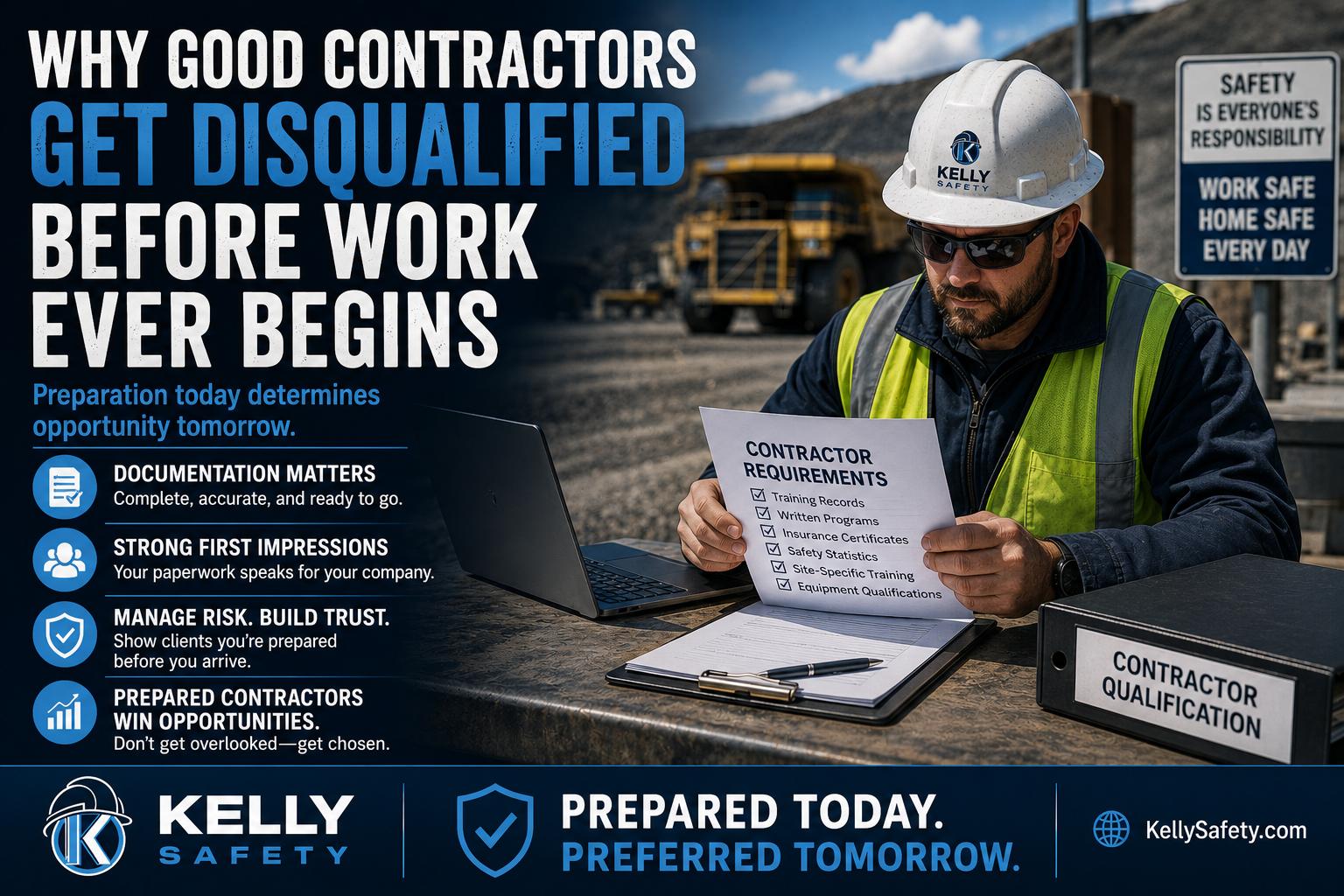
Many contractors assume they lose work because of price or competition. In reality, poor safety documentation, incomplete training records, and contractor qualification failures often eliminate opportunities before work ever begins.
8–9 Minute Read
Most contractors think they lose work because of price
When contractors lose a project opportunity, the assumption is usually the same. Someone else was cheaper, had a stronger relationship, or was available sooner. While those factors certainly influence decisions, many contractors never see what happens behind the scenes before pricing is even considered.
In today's construction, mining, and industrial environments, companies are often evaluated long before they receive approval to perform work. Safety documentation, contractor qualification requirements, training records, insurance information, and written programs frequently become the first impression a contractor makes on a prospective client. If those systems appear incomplete, disorganized, or inconsistent, concerns begin to develop before a proposal is ever reviewed.
Many contractors believe they lost the job because of cost when, in reality, they were never seriously considered in the first place.
Contractor qualification has changed the way opportunities are awarded
Years ago, contractor relationships were built primarily through reputation, referrals, and conversations. Those factors still matter, but today's project owners and mine operators are operating in a much different environment.
Contractor qualification has become a critical part of risk management. Owners want to understand who is entering their facilities, what training employees have received, how hazards are managed, and whether contractors have systems in place to support safe operations. As a result, contractor prequalification programs, onboarding requirements, and documentation reviews have become standard practice across many industries.
Before work begins, clients are evaluating whether a contractor appears prepared, organized, and capable of managing risk. That evaluation often begins with documentation, not performance in the field.
First impressions are increasingly made through documentation
One of the biggest shifts in contractor management is that first impressions no longer happen exclusively in person. More often, they happen through emails, qualification portals, training submissions, and document requests.
I've seen contractors spend significant time refining proposals while overlooking training records, written programs, or qualification requirements that were requested weeks earlier. By the time pricing discussions begin, the decision may already be moving in another direction.
When documentation is missing, incomplete, or difficult to produce, it creates questions that many contractors never realize are being asked. If a company struggles to provide basic safety information, clients naturally wonder how other aspects of the business are being managed.
That perception may not always be fair, but it is often reality.
Safety documentation communicates more than compliance
Many contractors view documentation as a compliance obligation. They create programs because they are required, maintain records because regulations demand it, and complete forms because clients ask for them.
Strong contractors view documentation differently.
They understand that documentation communicates professionalism. It demonstrates preparation, consistency, and operational control. When training records, written programs, and qualification documents are organized and readily available, clients gain confidence that the company operates with structure and accountability.
The documentation itself is important, but what it represents is often even more valuable.
The most common disqualification issues are preventable
Most contractor qualification failures are not caused by major safety violations or catastrophic incidents. More often, they involve relatively simple administrative gaps that could have been addressed long before they became a problem.
Missing training records, outdated written programs, incomplete onboarding documents, expired certificates, missing insurance information, and undocumented safety procedures are common examples. None of these issues necessarily reflect the quality of the work being performed, but they influence how clients perceive the company's ability to manage risk.
In competitive environments, even small gaps can become deciding factors.
Mine operators and project owners are managing risk differently today
Across mining, construction, and industrial operations, the expectations placed on contractors continue to increase. Owners are being asked to demonstrate stronger oversight of contractor activities, which means contractor management systems have become more detailed and more comprehensive than they were a decade ago.
This is particularly evident in mining, where operators often request training plans, site-specific training documentation, annual refresher records, and contractor qualification information before work begins. The goal is not simply compliance. The goal is reducing uncertainty and ensuring contractors arrive prepared to work safely.
Companies that understand this trend are far better positioned than those still treating documentation as an afterthought.
The strongest contractors make qualification easy
One characteristic shared by successful contractors is preparation. They do not wait until documentation is requested before trying to locate it. They build systems that allow information to be produced quickly, accurately, and consistently.
Training records are organized. Written programs are current. Insurance certificates are maintained. Training plans are already developed. Documentation is reviewed before it becomes urgent.
This preparation does more than improve compliance. It reduces delays, improves client confidence, and creates a smoother onboarding process whenever new opportunities arise.
Prepared contractors spend less time scrambling and more time focusing on operations.
Documentation should support operations, not create burdens
The goal is not to build paperwork for the sake of paperwork. The strongest documentation systems support the business while helping satisfy client expectations and regulatory requirements.
When built correctly, documentation becomes easier to manage, easier to update, and easier to produce when needed. Training plans, onboarding records, qualification documents, and written programs become tools that support operations instead of administrative burdens that only receive attention during audits or project mobilization.
That shift in mindset is often what separates reactive contractors from proactive ones.
Preparation has become a competitive advantage
Many contractors focus heavily on improving field performance, increasing efficiency, and controlling costs. Those efforts matter. However, opportunities are increasingly won and lost during qualification, onboarding, and documentation review long before field performance can even be demonstrated.
Companies that maintain strong documentation systems, organized training records, and professional qualification packages create confidence before they ever arrive on site. In many cases, that confidence becomes a competitive advantage.
Preparation is no longer simply a compliance issue. It has become part of doing business.
A Final Thought From the Field
Most contractors do not lose work because they lack the ability to perform it. They lose opportunities because they fail to demonstrate preparedness before work begins.
Project owners and mine operators are evaluating more than price. They are evaluating risk, organization, documentation, and confidence. Safety records, training plans, qualification systems, and written programs all contribute to that evaluation.
The strongest contractors understand that professionalism starts long before mobilization. It starts with preparation, and in today's environment, preparation often determines whether the opportunity exists in the first place.