
Lockout/Tagout Fails When the Procedure Doesn't Match the Work
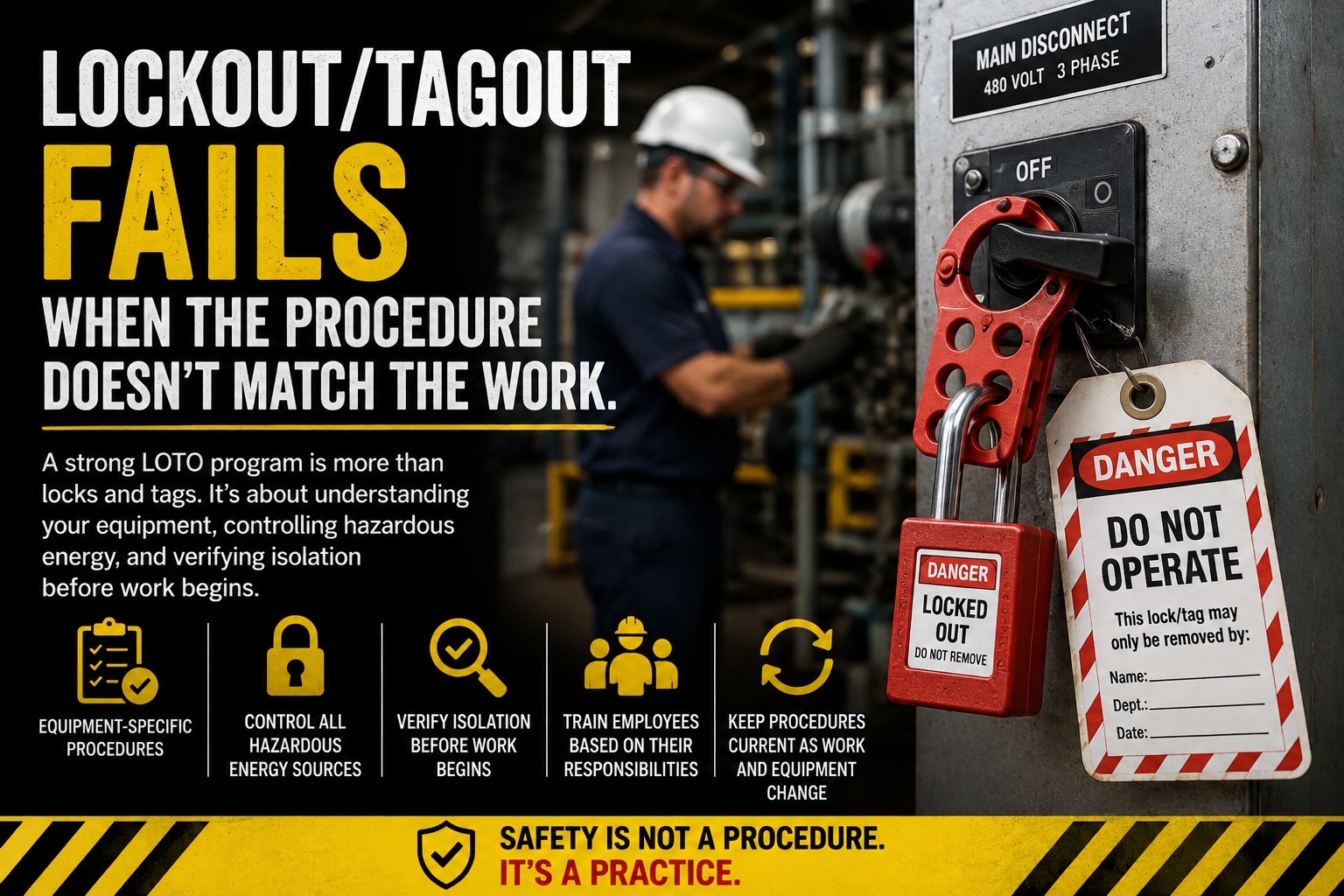
A written Lockout/Tagout program can look complete on paper and still fail in the field. When equipment changes, procedures become outdated, or experienced employees begin relying on shortcuts, dangerous gaps can develop between the program and the work.
5-7 Minute Read
5-7 Minute Read
Lockout/Tagout is one of those safety programs that can look remarkably good on paper. The company has a written energy control program, employees have completed training, locks and tags are available, and procedures exist somewhere in the safety manual. From a distance, everything appears to be in place.
The real test happens when someone actually opens a disconnect, closes a valve, blocks stored energy, and puts their hands inside a machine. At that point, the quality of the paperwork matters far less than whether the procedure accurately identifies the energy sources and gives the employee a reliable method for controlling them. A generic procedure that does not match the equipment or work being performed can create something particularly dangerous: confidence that hazardous energy has been controlled when it has not.
That is why effective Lockout/Tagout is ultimately about more than locks and tags. It is about understanding the equipment, identifying hazardous energy, establishing procedures that reflect actual field conditions, and verifying that the isolation worked before work begins.
The Written Program and the Field Have to Tell the Same Story
Most established companies understand that they need an energy control program. The challenge is making sure the program employees are expected to follow reflects what actually happens in the operation. Equipment gets modified, production lines change, contractors perform unfamiliar work, and maintenance personnel develop practical ways of completing tasks that may not resemble the procedure written several years earlier.
Over time, a gap can develop between the safety program and the work. The company may still have documentation showing that Lockout/Tagout is addressed, while employees in the field rely increasingly on experience, memory, or informal practices to determine how equipment should be isolated. That disconnect deserves attention because hazardous energy does not care how experienced the person performing the work happens to be.
A useful LOTO procedure should help an authorized employee answer practical questions before work begins. What energy sources are present? Where are the isolation points? Is stored or residual energy involved? What steps are required to shut the equipment down? How will isolation be verified? What needs to happen before the equipment is returned to service? If the procedure cannot reliably answer those questions for the equipment being serviced, having the procedure provides far less protection than the organization may assume.
Electrical Energy Is Only Part of the Problem
The padlock hanging from an electrical disconnect has become the familiar image of Lockout/Tagout, but hazardous energy takes many forms. Electrical energy may be present alongside hydraulic pressure, pneumatic pressure, mechanical movement, gravity, thermal energy, pressurized liquids, or other stored energy capable of injuring someone during servicing or maintenance.
That becomes especially important on complex equipment. Turning off the obvious electrical disconnect may stop normal operation without controlling every source capable of producing movement or releasing energy. A raised component may still fall. Hydraulic pressure may remain trapped. A pneumatic system may remain charged. Rotating equipment may continue moving after power has been removed.
Good energy control begins with identifying the hazards associated with the actual machine rather than assuming one isolation point controls everything. That requires knowledge of the equipment and a procedure developed around the way the system really operates.
Shutdown Is Not the Same as Isolation
Modern equipment has made normal shutdown easier than ever. Push buttons, touchscreens, emergency stops, control switches, and automated systems allow employees to stop machinery quickly. That convenience can also create confusion between stopping equipment and isolating hazardous energy.
A machine that is not running is not necessarily safe to service. Control circuitry can fail, another employee can activate a control, stored energy can release, and automated equipment can respond unexpectedly if hazardous energy has not been properly isolated. This is why energy control cannot end with pressing the stop button or assuming the equipment is safe because nothing is currently moving.
Employees performing servicing and maintenance need to understand the difference between normal operational controls and energy-isolating devices. More importantly, that distinction needs to be reflected in the company's procedures and training. If employees have developed a habit of treating "off" as equivalent to "isolated," the organization has a problem that another annual training certificate alone will not solve.
Verification Is Where Assumptions End
One of the most important parts of effective energy control happens after locks have been applied. Before an employee begins work, there must be confidence that the hazardous energy has actually been isolated and controlled.
That is where verification matters.
A worker may follow the shutdown sequence correctly, identify the appropriate isolation devices, apply locks and tags, and address stored energy. Verification provides the final check that those actions accomplished what they were intended to accomplish. It turns an assumption into confirmation before someone enters the point of operation, removes a guard, begins maintenance, or places part of the body in a location where unexpected energization could cause serious injury.
The exact verification method depends on the equipment and energy involved, which is another reason generic procedures can be inadequate. Effective Lockout/Tagout is equipment-driven. The employee needs to know not only that verification is required, but how to verify isolation for the system being serviced.
Experienced Employees Can Be Especially Vulnerable to Normalized Shortcuts
New employees are often viewed as the workers most likely to make mistakes, but hazardous-energy incidents can also involve people who know the equipment extremely well. Familiarity changes the way people perceive risk. A maintenance employee who has performed the same task hundreds of times may know exactly how long the repair takes, which components normally move, and which steps have never seemed necessary before.
Experience is valuable, but repetition can normalize shortcuts. A task that began with a complete shutdown and isolation process can gradually become "just a quick adjustment." A guard is removed without full isolation because the machine is only going to be down for a minute. A coworker watches the controls instead of applying energy control because everyone involved has done it before.
The problem is not necessarily a lack of safety knowledge. It is the gradual replacement of a formal system with familiarity and assumptions. Strong LOTO programs account for that human tendency by making energy control a normal part of maintenance work rather than an obstacle employees are expected to work around.
Contractors Add Another Layer of Complexity
Lockout/Tagout becomes more complicated when outside contractors enter an operating facility. The host employer understands its equipment and energy control program, while the contractor brings its own employees, procedures, locks, training, and experience. Both groups may be competent, yet differences between their systems can still create confusion.
Before servicing begins, everyone involved needs a clear understanding of how hazardous energy will be controlled and how the respective procedures affect the work. This becomes particularly important during shutdowns, outages, equipment installations, and major maintenance activities where several employers or trades may be working around the same systems.
Contractor coordination should not begin after someone discovers that two crews have different assumptions about who controls the equipment. The expectations, isolation responsibilities, communication process, and return-to-service procedures need to be understood before work starts. For contractors, the ability to demonstrate a structured LOTO program also communicates something important to clients: the company is prepared to manage high-risk work rather than simply provide labor.
Training Has to Match Employee Responsibilities
Not everyone interacting with equipment has the same role in an energy control program. Employees performing Lockout/Tagout need a different level of knowledge than employees who operate or work around equipment being serviced. Other workers may simply need to understand the purpose of the program and why locked or tagged equipment must not be disturbed.
Training should reflect those responsibilities. Authorized employees need the knowledge necessary to recognize hazardous energy sources, understand the magnitude and type of energy present, and apply the methods required for isolation and control. Employees affected by Lockout/Tagout need to understand the purpose and use of the procedure, while other employees whose work may bring them into the area need appropriate instruction regarding the restrictions associated with the program.
This is where training and written procedures need to work together. Training provides employees with the knowledge to understand hazardous energy and the energy-control process. Procedures translate those principles into specific actions for the equipment and work being performed. One does not eliminate the need for the other.
Organizations reviewing their hazardous-energy training can explore Kelly Safety's OSHA training resources at KellySafety.com/osha, including training designed to help employees better understand workplace hazards and the systems used to control them.
A LOTO Program Has to Change When the Work Changes
One of the easiest ways for an energy control program to become outdated is simply for the business to evolve. New equipment is installed. Old machinery is modified. Production processes change. Isolation points are relocated. New energy sources are introduced. Maintenance responsibilities shift between employees and contractors.
The written program and associated procedures need to keep pace with those changes. A procedure developed for the original equipment configuration may no longer provide accurate instructions after a significant modification. Likewise, an annual review that becomes nothing more than a signature on a form can miss the opportunity to identify the shortcuts, misunderstandings, or equipment changes that have developed in the field.
Periodic inspection should be treated as an operational check on the system rather than an administrative exercise. It is an opportunity to determine whether procedures remain adequate, whether employees are following them, and whether changes are needed before an assumption becomes an incident.
The Best Procedure Is the One Employees Can Actually Use
There is a temptation in safety management to believe that more documentation automatically creates a stronger program. Lockout/Tagout is a good example of why that is not always true. A fifty-page energy control document provides little value to the mechanic standing in front of a machine if it does not clearly explain how that machine needs to be isolated.
Strong programs combine regulatory requirements with practical execution. Procedures should be accurate enough to control the hazards, clear enough for authorized employees to follow, and specific enough to reflect the equipment being serviced. Supervisors should understand how the program works, employees should receive training appropriate to their responsibilities, and the organization should have a method for identifying when procedures no longer match field conditions.
That level of discipline does more than satisfy a compliance requirement. It creates confidence that when an employee applies a lock and begins work, the hazardous energy capable of hurting that person has actually been controlled.
A Final Thought From the Field
Lockout/Tagout failures rarely begin with a company deciding that hazardous energy does not matter. More often, the system slowly becomes disconnected from the work. Procedures age, equipment changes, experienced employees develop shortcuts, and assumptions gradually replace verification.
The solution is not simply more paperwork or another lock hanging on a board. It is making sure the written program, equipment-specific procedures, employee training, contractor coordination, and actual field practices continue to work together.
A Lockout/Tagout program should accurately describe how hazardous energy is controlled where the work is actually happening. When the procedure and the field no longer match, the procedure needs attention before someone discovers the difference the hard way.