
OSHA’s HazCom 2024 Update: What Employers Need to Do Before November 2026
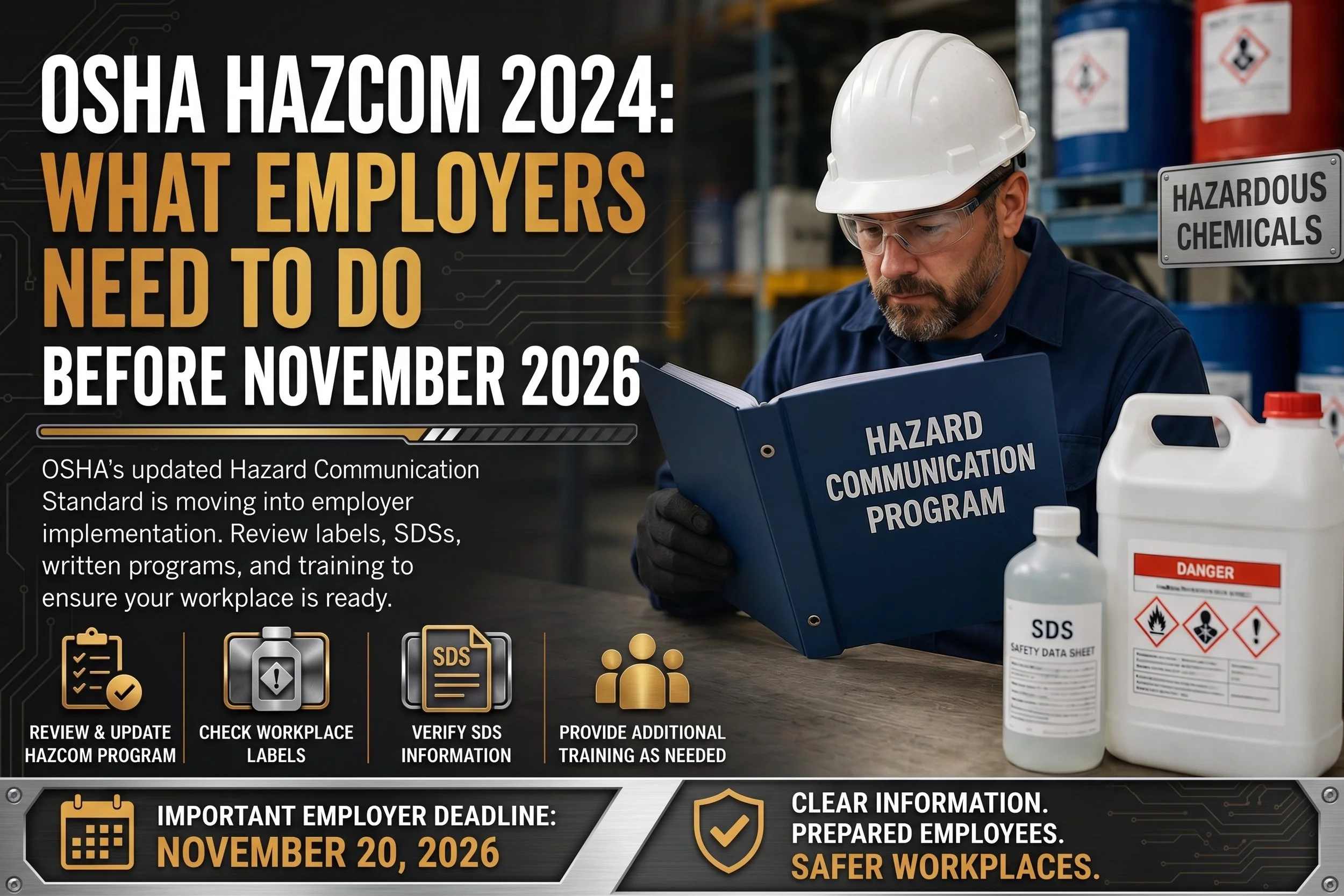
OSHA's updated Hazard Communication Standard is moving into employer implementation, with an important deadline approaching on November 20, 2026. Employers should review workplace labels, written HazCom programs, Safety Data Sheets, and employee training to determine what updates are necessary
8–9 Minute Read
Hazard Communication is one of the most familiar safety requirements in American workplaces. Most contractors have a written program, Safety Data Sheets are maintained somewhere within the organization, chemical containers are labeled, and employees have received some level of Hazard Communication training. Because the basic framework has been in place for decades, it is easy for employers to assume that once a HazCom program is established, very little changes.
That assumption deserves another look in 2026.
OSHA's 2024 update to the Hazard Communication Standard is now moving further into its implementation schedule. After extending the original compliance dates earlier this year, OSHA required chemical manufacturers, importers, and distributors evaluating substances to comply with the revised provisions by May 19, 2026. The next major date directly affecting employers is November 20, 2026, when employers must, as necessary, update workplace labeling, their written Hazard Communication programs, and provide additional employee training for newly identified hazards associated with substances.
For contractors and employers, this is not a reason to panic or automatically retrain every employee in November. It is, however, a very good reason to review the Hazard Communication system your company may have been using for years.
Hazard Communication Has Changed, Even If the Basic Responsibility Has Not
OSHA published its updated Hazard Communication Standard in May 2024, primarily aligning the rule with the seventh revision of the United Nations Globally Harmonized System of Classification and Labelling of Chemicals. The purpose of the update is still consistent with the foundation of HazCom: employees need accurate information about the hazardous chemicals they may encounter, and that information must be communicated through classification, labels, Safety Data Sheets, written programs, and training.
The 2024 changes affect how certain hazards are classified and how information is presented on labels and Safety Data Sheets. OSHA also addressed issues that developed after implementation of the 2012 standard, including provisions involving small containers and other areas where the agency believed hazard information could be communicated more effectively. For the average contractor, many of those upstream classification responsibilities belong to chemical manufacturers and importers rather than the employer using the product in the field.
That does not mean downstream employers can ignore the changes. Updated hazard information eventually reaches the workplace through revised labels and SDSs, and employers are responsible for making sure their own Hazard Communication systems accurately reflect the chemicals and hazards present in their operations.
November 20 Is an Employer Review Date, Not an Automatic Retraining Date
One of the easiest mistakes companies can make with a regulatory change is converting a specific requirement into a blanket rule that OSHA never created. The November 20, 2026 deadline does not mean every employee in the country must automatically sit through another complete Hazard Communication course.
OSHA's requirement is more specific. For substances, employers must update alternative workplace labeling, their Hazard Communication program, and provide additional employee training as necessary for newly identified physical hazards, health hazards, or other hazards covered by the standard. That distinction matters because the correct response depends on what has actually changed within the employer's chemical inventory and hazard information.
A contractor whose updated SDSs identify new hazard information may need to revise parts of the written program, make sure workplace labels still communicate the appropriate information, and provide employees with additional training addressing those newly identified hazards. Another employer may review its program and determine that fewer changes are necessary. Compliance should be based on the chemicals and hazards actually present in the workplace rather than treating November 20 as a universal annual retraining deadline.
The First Step Is Reviewing the Chemical Information You Already Have
Most employers do not need to begin their HazCom review by rewriting the entire program. A better starting point is the chemical inventory and the Safety Data Sheets associated with those products. Employers should determine whether manufacturers or suppliers have provided updated SDSs and whether any revised classifications or hazard information affect the way those chemicals are used or communicated within the workplace.
That review should also include workplace labeling. Contractors frequently transfer chemicals into secondary containers, use alternative labeling systems, or manage chemicals across multiple projects and crews. If the underlying hazard information has changed, the communication employees rely upon in the field needs to remain accurate as well.
The written Hazard Communication program should then be reviewed against those conditions. A program that still references outdated terminology, old chemical information, or procedures that no longer reflect the company's operations may technically exist while providing very little practical value. Regulatory changes are often a useful reminder that written programs need to function in the workplace, not simply remain stored in a binder or shared drive.
Training Should Focus on What Employees Actually Need to Know
Hazard Communication training is most useful when employees understand the hazards associated with the chemicals they actually encounter. Generic instruction has value because workers need to understand labels, pictograms, Safety Data Sheets, protective measures, and the basic structure of the Hazard Communication Standard. However, effective training also connects those concepts to the workplace.
If updated hazard information changes what employees need to understand about a substance, the additional training should address that change directly. Workers should know what the newly identified hazard is, how they may be exposed, what protective measures apply, and where they can obtain additional information. Simply repeating an old training presentation without addressing the revised hazard information misses the purpose of the requirement.
This is also why employers should be cautious with course descriptions or company materials that simply state that training is "GHS compliant." OSHA's current framework is the Hazard Communication Standard as updated in 2024, which primarily aligns with GHS Revision 7. Training materials, written programs, webpages, and internal documentation should accurately reflect the standard currently moving through implementation rather than relying on terminology left over from previous versions.
OSHA Has Also Updated How the Standard Will Be Inspected
The compliance schedule is not the only development employers should recognize. On May 19, 2026, OSHA issued CPL 02-02-079, Inspection Procedures for the Hazard Communication Standard (HCS 2024). The directive provides OSHA compliance personnel with inspection and enforcement procedures for the revised standard.
For employers, the practical takeaway is straightforward. HCS 2024 is no longer simply a rule published in the Federal Register waiting somewhere in the future. OSHA has now established inspection procedures specifically addressing the updated standard while the regulated community moves through its phased compliance dates.
That makes 2026 an appropriate time for contractors to look critically at their Hazard Communication systems rather than waiting until an inspection, customer audit, or incident exposes gaps. Chemical inventories, SDS access, labeling practices, written procedures, and employee knowledge should all tell the same story when someone asks how hazardous chemicals are managed within the organization.
Employers Should Also Understand That the Transition Continues Beyond 2026
The November 20, 2026 employer deadline applies to substances, but HCS 2024 implementation does not end there. OSHA established a later schedule for mixtures. Chemical manufacturers, importers, and distributors evaluating mixtures have until November 19, 2027 to comply with the revised provisions, and employers have until May 19, 2028 to make necessary workplace labeling, program, and training updates associated with newly identified hazards for mixtures.
That phased schedule is important because employers may continue receiving revised hazard information from suppliers over an extended period. HazCom should therefore be treated as an active management system rather than a one-time project completed in November 2026. As new SDSs and labels enter the workplace, employers should have a process for reviewing the information and determining whether changes affect employee training or workplace procedures.
Companies that already maintain an organized chemical inventory and current SDS library will be in a much stronger position to manage that transition. Those relying on outdated binders, scattered electronic files, or informal labeling practices may find that the regulatory update exposes weaknesses that existed long before HCS 2024.
This Is a Good Time to Review More Than the Deadline
The November deadline creates a compliance reason to review Hazard Communication, but employers should use the opportunity to ask a broader question: does the program actually work?
Employees should be able to locate Safety Data Sheets without confusion. Containers should carry meaningful and legible hazard information. The written program should describe what the company really does. Supervisors should understand their responsibilities, and workers should recognize the hazards associated with the products they use rather than simply remembering that they once completed a HazCom course.
That is the difference between possessing compliance documents and operating an effective Hazard Communication program. Regulations establish the minimum expectations, but implementation determines whether the information actually protects anyone in the field.
Preparing for HCS 2024 Without Creating Unnecessary Complexity
For most contractors, preparing for the next phase of HCS 2024 does not require building an entirely new safety system. It requires reviewing what is already in place, comparing it with current chemical information, correcting outdated materials, and providing additional employee training where newly identified hazards make that necessary.
Kelly Safety is also reviewing our Hazard Communication training materials to ensure they accurately reflect the current OSHA framework and the HCS 2024 transition. Contractors reviewing their own programs can use this period to make sure training, written procedures, labels, and SDS management remain aligned rather than treating each requirement as a separate compliance exercise.
Organizations looking to strengthen employee training can explore Kelly Safety's OSHA training resources at KellySafety.com/osha. Hazard Communication remains one of the foundational elements of workplace safety, and the current regulatory transition provides a practical opportunity to make sure the program employees rely upon is as current as the chemicals they are working with.
A Final Thought From the Field
Hazard Communication has always been built around a simple principle: workers have the right to understand the chemical hazards they face and how to protect themselves. HCS 2024 does not change that principle, but it does change portions of the system used to communicate that information.
The November 20, 2026 deadline should therefore be viewed as more than another date on a compliance calendar. It is an opportunity for employers to verify that workplace labels, written programs, Safety Data Sheets, and employee training continue to reflect the hazards actually present in their operations.
The companies that handle this transition well will not be the ones that simply schedule another course and check a box. They will be the ones that review the information, determine what has changed, communicate those changes clearly, and make sure their employees understand what they need to know before the next job begins.