
The Fallacy of "Quick Maintenance": Why Lockout/Tagout Failures Continue to Drive Severe OSHA Citations
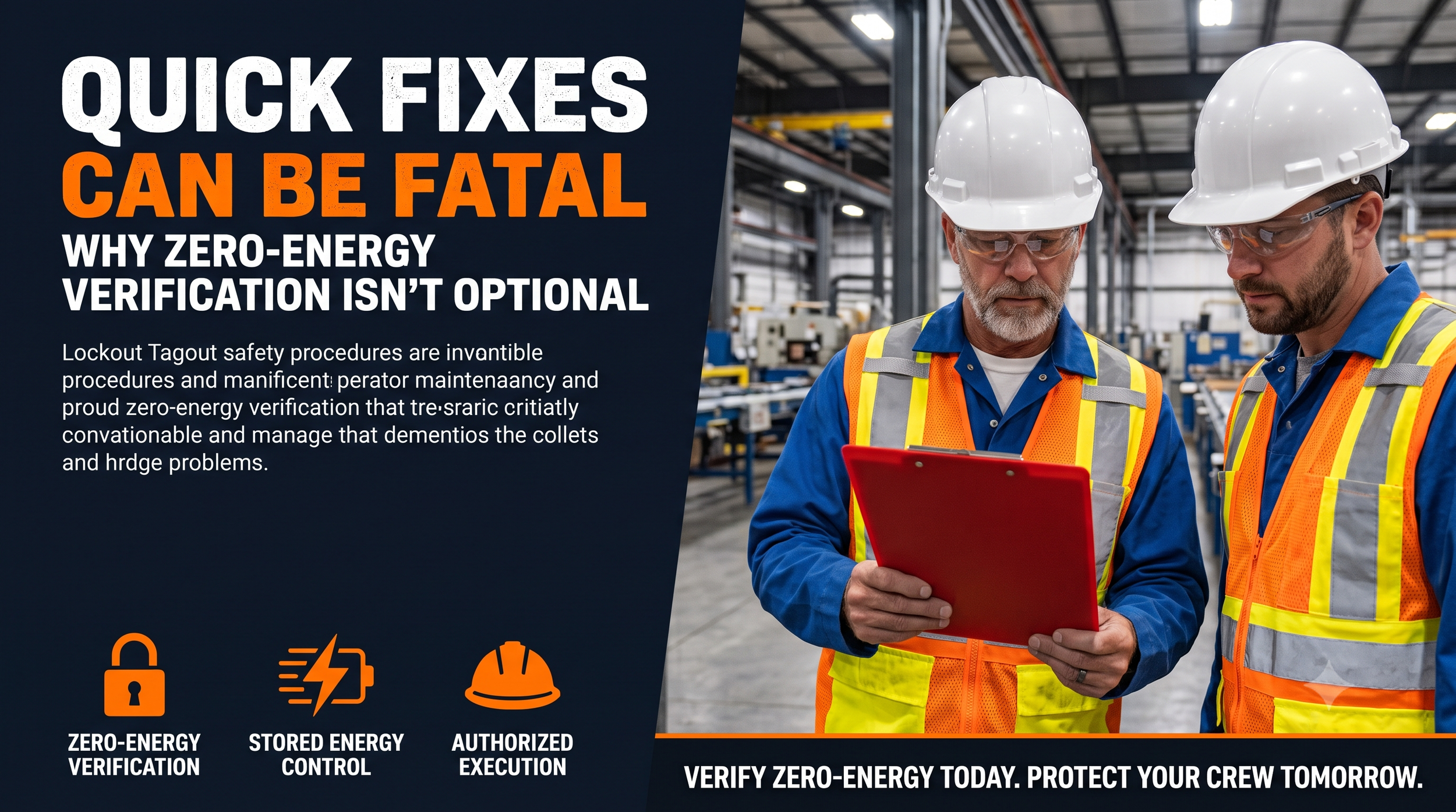
Skipping Lockout/Tagout steps for "quick fixes" remains one of the primary drivers of severe OSHA citations and catastrophic machinery injuries. This article breaks down the operational differences between machine guarding and true zero-energy isolation.
7–8 Minute Read
7–8 Minute Read
On almost any industrial, manufacturing, or heavy construction jobsite, operational efficiency is continuously measured. Production schedules are tight, downtime is expensive, and facility managers face constant pressure to keep equipment running. When a conveyor jams, a packing machine misfeeds, or a hydraulic line requires a minor seal adjustment, the immediate temptation for field crews is to resolve the issue as quickly as possible. In many workplaces, this manifests as a dangerous operational shortcut: performing a "quick fix" without taking the time to achieve a verified zero-energy state.
This gap between written safety policy and field practice is one of the primary reasons Lockout/Tagout (LOTO) violations under 29 CFR 1910.147 consistently rank among OSHA's most frequently cited standards year after year. The issue is rarely that an organization lacks a written energy control program entirely. More often, the breakdown occurs because employees treat lockout procedures as a lengthy administrative burden reserved only for major equipment overhauls rather than a non-negotiable prerequisite for any service or maintenance activity.
The True Cost of Energy Control Breakdowns
When an employee bypasses lockout procedures to clear a jam or perform routine maintenance, they are making a high-risk gamble against stored mechanical, electrical, hydraulic, or pneumatic energy. Unintended equipment re-energization or the sudden release of stored kinetic energy can result in catastrophic injuries, including traumatic amputations, severe crushing injuries, arc flash burns, or fatalities. These incidents happen in a fraction of a second, leaving zero margin for error.
Beyond the tragic physical impact on workers and their families, the operational consequences of a LOTO failure can severely disrupt a business:
Severe Penalties: OSHA penalties for LOTO violations frequently cross into "Willful" or "Repeat" classifications, carrying fines that exceed $160,000 per violation.
Operational Disruptions: Serious workplace injuries trigger immediate federal or state OSHA investigations, leading to prolonged equipment downtime, site shutdowns, and thorough operational audits.
Surging Insurance Costs: Catastrophic injuries inflate Experience Modification Rates (EMR) and Total Recordable Incident Rates (TRIR), driving up workers' compensation premiums and threatening commercial insurance coverage.
Loss of Prequalification: High-severity incidents and elevated safety metrics can instantly disqualify contractors from bidding on major industrial, mining, or Tier-1 commercial projects.
Understanding the Difference Between Machine Guarding and Zero-Energy Isolation
One of the most common operational misunderstandings on the shop floor involves the distinction between physical machine guarding and Lockout/Tagout. Machine guards are designed to protect operators during normal production operations. They prevent workers from entering point-of-operation hazard zones while the machine is performing its intended manufacturing function.
However, the moment a worker opens an interlocked gate, removes a guard, or positions any part of their body inside a machine's point of operation to clear a blockage, adjust a sensor, or perform maintenance, normal production has ceased. At that exact moment, machine guarding is no longer the primary line of defense. The task transitions entirely into the domain of energy control, requiring physical lock application and verification of a zero-energy state.
Assuming that an interlocked door, an emergency stop button, or a control-circuit switch provides adequate protection during service work is a critical error. Control-circuit devices can fail, be bypassed, or experience electrical faults. Federal safety standards explicitly state that control-circuit devices cannot be used as energy isolating devices for Lockout/Tagout purposes. Physical isolation of the primary energy source is mandatory.
The Overlooked Threat: Stored and Residual Energy
Achieving a true zero-energy state requires far more than simply flipping a main breaker or closing a supply valve. Many of the most severe industrial accidents occur after primary power sources have been disconnected because workers failed to identify and dissipate stored or residual energy within the system.
A comprehensive energy control program must account for every form of energy capable of re-energizing a machine or moving mechanical components. Gravitational energy poses a constant threat through raised counterweights, elevated press rams, or unsupported mechanical arms that can fall under their own weight. Trapped hydraulic or pneumatic pressure in lines, air receivers, and fluid accumulators can release abruptly during disassembly.
Mechanical tension trapped in coiled springs, cables, or rotating flywheels must be neutralized before work begins. Similarly, thermal and chemical energy lingering in pressurized piping or steam conduits must be safely vented and cooled. A complete lockout procedure demands that stored gravitational energy is physically pinned or blocked, pressure lines are bled, spring tension is released, and thermal systems are allowed to cool before any employee places themselves in harm's way.
Closing the Gap: Equipment-Specific Procedures and Practical Training
Building a compliant and protective Lockout/Tagout culture requires shifting from generic rules to clear, site-specific operational execution. A binder containing a general energy control policy stored in a front office will not prevent an injury on the plant floor. Organizations must establish clear, visual, equipment-specific procedures posted directly at or near every complex piece of machinery.
These visual procedures should clearly identify energy isolation points, the specific hardware required, step-by-step shutdown sequences, and specific methods for bleeding or blocking stored energy. Most importantly, every procedure must define the exact testing sequence required to verify zero-energy state—such as attempting to restart the equipment locally after verifying that isolation devices are locked out.
Furthermore, training must go beyond an annual slide presentation. Authorized employees who execute lockouts need hands-on practice on the actual equipment they service. Affected employees who operate near locked-out machinery must understand the strict policy that no lock or tag is ever removed by anyone other than the authorized person who applied it. Supervisors must actively audit these practices in the field to ensure that production deadlines never supersede isolation protocols.
Building Authority and Workforce Competency Through Kelly Safety
Developing and maintaining a rigorous energy control program requires continuous field oversight, practical training, and clear supervisor accountability. Kelly Safety helps contractors, plant managers, and safety directors bridge the gap between regulatory requirements and daily shop-floor behavior.
To ensure your workforce is thoroughly trained and qualified, Kelly Safety provides specialized instructor-led and online general industry safety programs. Organizations looking to elevate their workforce development efforts can explore our complete training offerings at KellySafety.com/osha for general industry and construction standards, as well as specialized mining compliance options at KellySafety.com/msha.
Whether you need Live Virtual Instructor-Led Training (VILT), site-specific safety courses, or ongoing safety management support, Kelly Safety delivers practical, field-tested guidance designed to keep your crews safe and your operations moving forward without interruption.
Zero-Energy Verification Is Your Last Line of Defense
Production demands will always exist, but no job clear-out or routine maintenance task justifies risking a life-altering injury. Lockout/Tagout is not a dynamic framework where steps can be skipped for convenience. It is an exact, disciplined process designed to protect workers from unpredictable machine hazards.
When organizations invest in clear equipment procedures, proper hardware, thorough employee training, and strong supervisor accountability, they transform energy control from a burdensome compliance obligation into an effective operational standard.
Because in safety, taking a "quick minute" without locking out is never worth losing a lifetime.