
Safety Doesn't Work If Workers Don't Understand It
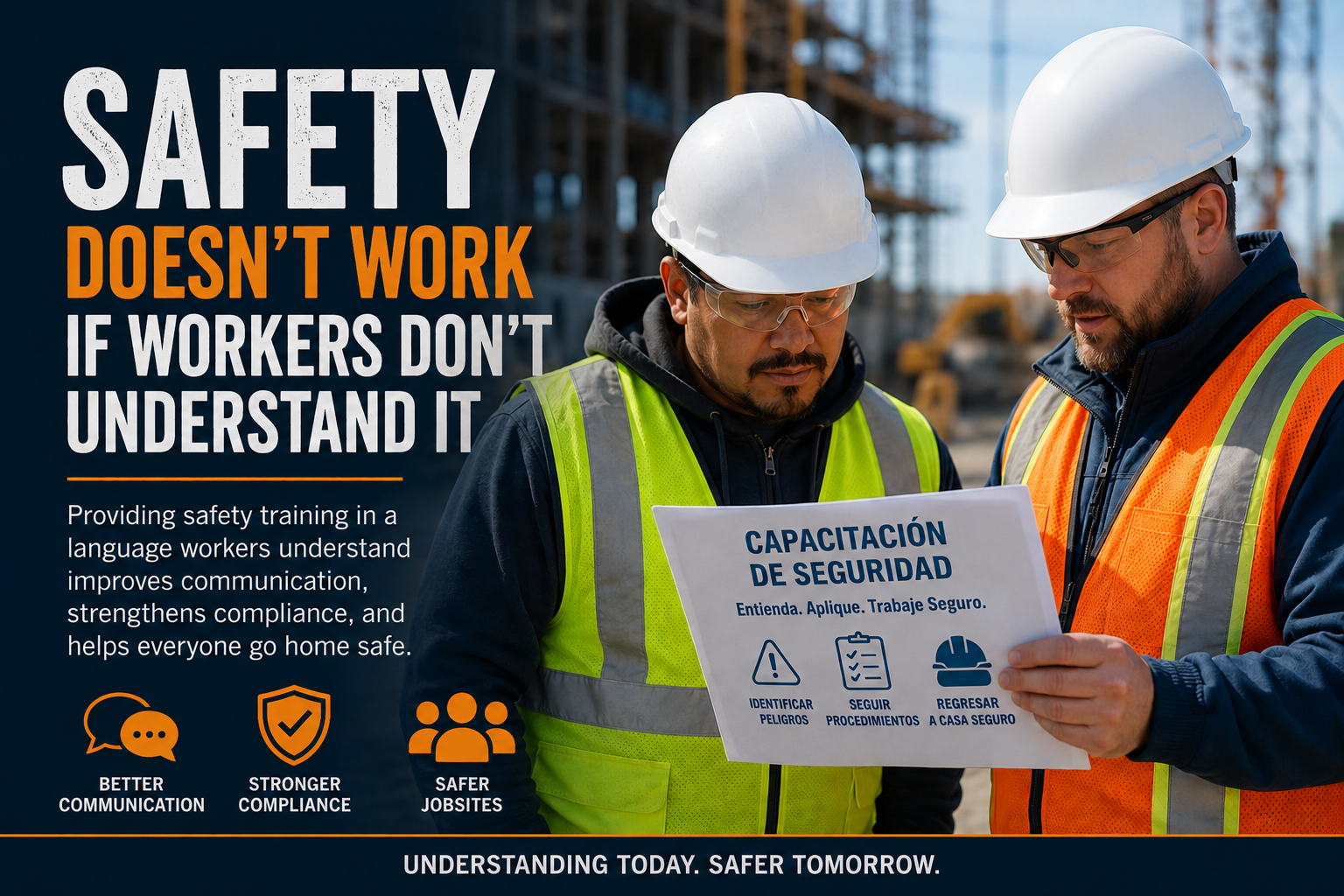
A safety program is only effective if workers understand it. Learn why Spanish-language safety training improves communication, strengthens compliance, reduces risk, and helps contractors build safer construction, mining, and industrial workplaces.
8–9 Minute Read
Every employer shares the same goal: ensuring every employee returns home safely at the end of the day. Companies invest significant time and resources into developing written safety programs, conducting orientation, delivering OSHA and MSHA training, holding toolbox talks, and establishing procedures designed to reduce risk. These efforts are essential because they provide the foundation upon which safe workplaces are built.
Yet one of the most overlooked barriers to workplace safety has nothing to do with equipment, policies, or regulations. It is communication. A safety program can be well written, thoroughly documented, and fully compliant with regulatory requirements, but if employees cannot clearly understand the information being communicated, the effectiveness of that entire program begins to diminish. As the construction, mining, and industrial workforce continues to evolve, providing safety training in a language workers understand has become an operational necessity rather than simply a convenience.
The Workforce Has Changed, and Safety Programs Must Evolve With It
Across the United States, contractors increasingly rely on Spanish-speaking employees to perform essential work in construction, mining, manufacturing, and industrial operations. These workers build infrastructure, operate equipment, perform maintenance, and contribute to nearly every aspect of a successful project. Their experience and skills have become an important part of today's workforce, and many companies simply could not meet project demands without them.
While the workforce has evolved, many safety programs have remained largely unchanged. Orientation materials, written procedures, toolbox talks, and formal training are still frequently delivered only in English, with the expectation that bilingual coworkers or supervisors will fill in any communication gaps. Although these efforts are usually well-intentioned, they often create inconsistencies that leave too much room for misunderstanding. When workers rely on assumptions rather than a clear understanding of safety expectations, the potential for mistakes increases.
Effective Communication Is One of the Most Powerful Safety Tools Available
Every successful safety program depends on communication. Employees must understand hazards before they can recognize them, understand procedures before they can follow them, and understand expectations before they can consistently meet them. When language becomes a barrier, the effectiveness of every other part of the safety program begins to decline.
This becomes particularly important during higher-risk activities where clear communication is essential. Lockout/tagout procedures, confined space entry, hazard communication, emergency response, equipment operation, and evacuation procedures all require workers to understand not only what they are expected to do, but why those expectations exist. If employees leave training uncertain about critical information, the organization has created unnecessary exposure that may not become apparent until an incident occurs.
Translation Alone Does Not Create Understanding
Many employers genuinely want to support their Spanish-speaking workforce. They ask bilingual supervisors to interpret during meetings, rely on experienced employees to explain procedures, or translate a handful of written documents. While these approaches demonstrate a commitment to helping employees succeed, they rarely provide the consistency necessary to build a strong safety culture.
Professional safety training involves much more than translating words from one language to another. Technical terminology, regulatory requirements, hazard recognition, emergency procedures, and industry-specific concepts must all be communicated accurately and consistently. Employees also need the opportunity to ask questions, participate in discussions, and fully understand how those concepts apply to the work they perform every day. Providing professional training in a language workers understand helps eliminate uncertainty while giving employees the confidence to apply what they have learned in the field.
Better Communication Creates Stronger Teams
Providing Spanish-language safety training is often viewed as something that primarily benefits Spanish-speaking employees. In reality, the benefits extend across the entire workforce. Construction, mining, and industrial operations rely on teamwork, coordination, and shared responsibility. Every crew member must be able to communicate changing conditions, identify hazards, and understand how their work affects those around them.
When employees clearly understand safety expectations, they are more likely to ask questions, report hazards, participate in discussions, and stop work when something appears unsafe. Those behaviors strengthen communication throughout the organization and help create an environment where safety becomes part of everyday operations rather than simply another compliance requirement. Improving understanding ultimately improves teamwork, and stronger teams make better decisions on the jobsite.
Investing in Spanish-Language Training Demonstrates Leadership
Organizations that provide safety training in a language employees understand are doing more than meeting a workforce need. They are demonstrating leadership. They recognize that every employee deserves the opportunity to fully understand company expectations, recognize workplace hazards, and perform work safely regardless of their primary language.
That investment also communicates something important to the workforce. It shows employees that leadership values their success enough to ensure they receive the same quality instruction and opportunity to learn as everyone else. In industries where attracting and retaining skilled workers continues to be a challenge, that commitment helps build trust, improve engagement, and strengthen relationships between employees and management.
Technology Has Made Multilingual Training More Accessible Than Ever
Not long ago, providing professional Spanish-language safety training often meant searching for qualified bilingual instructors, coordinating travel, and working around limited schedules. For many contractors, those challenges made multilingual training difficult to implement consistently.
Today, technology has changed that reality. Professional online courses, Live Virtual Instructor-Led Training (VILT), and bilingual learning platforms have made quality safety training more accessible than ever before. Contractors can now deliver consistent instruction to employees across multiple jobsites while reducing scheduling challenges and maintaining the flexibility today's workforce demands.
Organizations looking to strengthen their workforce development efforts can explore Kelly Safety's OSHA training programs at KellySafety.com/osha and MSHA training programs at KellySafety.com/msha, including our growing selection of Spanish-language training solutions designed to support today's workforce.
Safety Begins With Understanding
Every employer wants employees to return home safely. Achieving that goal requires more than written programs, annual refresher courses, and compliance documentation. It requires ensuring every worker clearly understands the information being presented and has the confidence to apply it on the job.
Language should never prevent someone from recognizing a hazard, understanding an emergency procedure, or asking an important question before beginning work. When organizations remove communication barriers, they strengthen every part of their safety program because understanding becomes the foundation upon which safe decisions are made.
At Kelly Safety, we believe every worker deserves access to professional safety training in a language they fully understand. Whether training is delivered online, through Live Virtual Instructor-Led Training, or in person, the objective remains the same: helping every employee return home safely at the end of the day.
Because effective safety training is not measured by whether information was presented.
It is measured by whether it was understood.