
OSHA 10 Is a Starting Point, Not a Safety Program
8–9 Minute Read
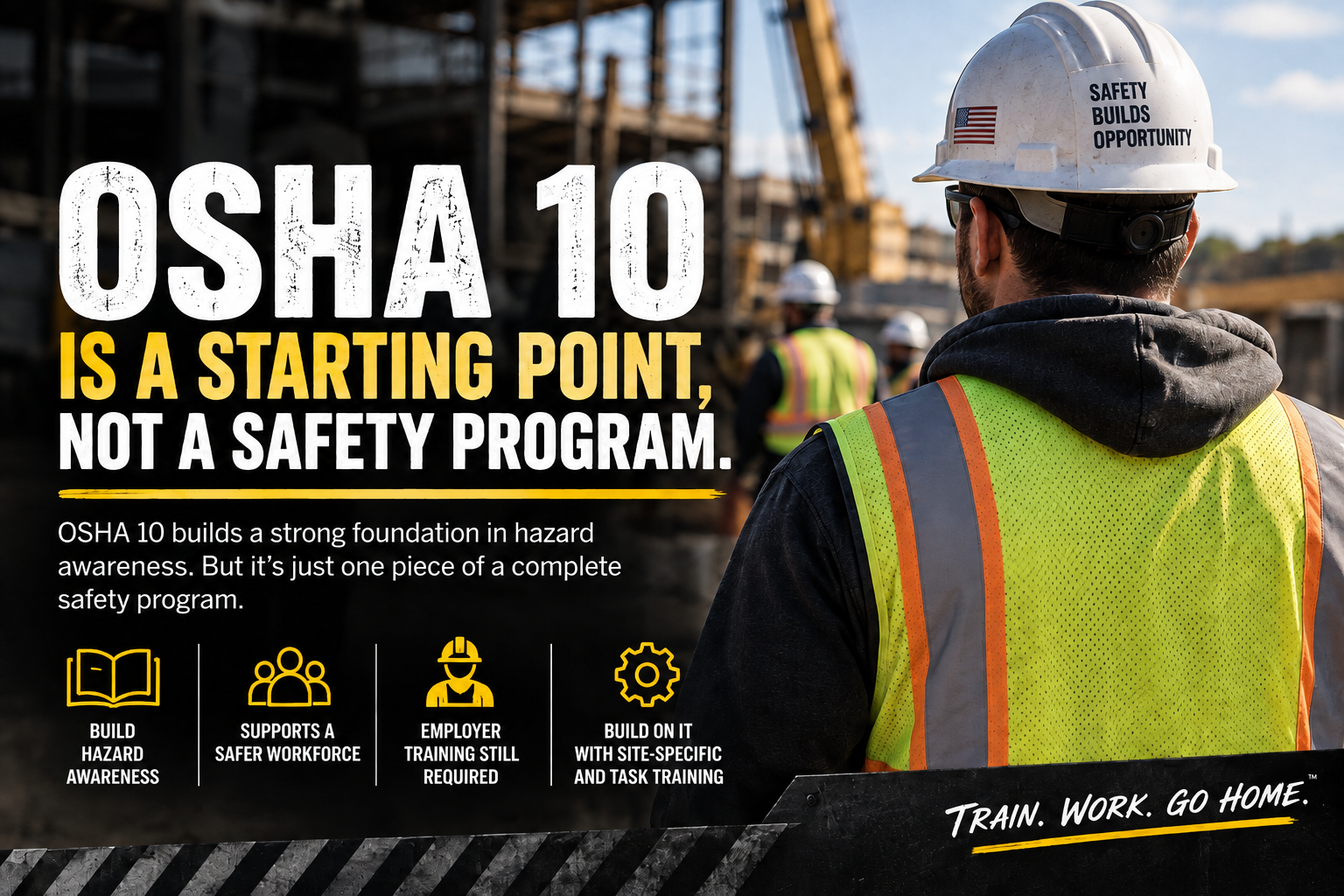
OSHA 10 provides workers with an important foundation in hazard recognition and workplace safety, but the training was never intended to replace employer, jobsite, or task-specific training.
For many workers entering construction or general industry, OSHA 10 is one of their first formal introductions to workplace safety. It provides a foundation for recognizing common hazards, understanding basic employee rights and employer responsibilities, and beginning to think differently about the conditions workers encounter every day. For contractors, it also provides a recognizable training credential that can help establish a baseline level of safety awareness across a workforce.
The problem begins when that baseline is treated as the finish line.
An OSHA 10 card tells an employer that a worker completed an OSHA Outreach Training Program course. It does not tell the employer that the worker has been trained on every hazard associated with a particular job, understands the company's procedures, knows the expectations of a specific project, or is qualified to perform specialized work. OSHA itself describes the 10-hour course as basic hazard-awareness training and makes clear that Outreach training does not satisfy the training requirements contained in specific OSHA standards. (OSHA)
That distinction is important. OSHA 10 can be an excellent starting point for building a safer workforce, but the responsibility for developing that workforce continues long after the card is issued.
OSHA 10 Was Designed to Build Hazard Awareness
The value of OSHA 10 becomes clearer when we understand what the program is intended to accomplish. OSHA describes the 10-hour course as providing workers with awareness of common job-related safety and health hazards. The program addresses hazard recognition, avoidance, abatement, and prevention while also introducing workers to their rights and employer responsibilities. (OSHA)
That is a valuable foundation, particularly for someone entering an industry where hazards may be unfamiliar. A new construction worker may encounter fall exposures, electrical hazards, moving equipment, excavations, ladders, scaffolds, power tools, and dozens of other conditions during a relatively short period of time. Developing the ability to recognize that something is wrong before interacting with the hazard is an important first step.
It also creates a common safety vocabulary. When supervisors discuss fall protection, struck-by hazards, caught-in or-between exposures, or electrical hazards, workers who have completed OSHA 10 should have some familiarity with those concepts. That makes future training and jobsite communication easier because the employer is not necessarily starting from zero.
But awareness and qualification are two different things. Knowing that a hazard exists does not automatically mean someone has been trained to perform every task associated with that hazard.
The OSHA Card Is Not a Certification
This is one of the most common misunderstandings surrounding OSHA 10 and OSHA 30. Workers routinely refer to themselves as "OSHA certified," and employers sometimes use similar terminology when discussing training requirements.
OSHA is much more specific. Individuals who successfully complete an Outreach course receive a student course completion card. OSHA states that the card is not considered a certification or license. The federal OSHA Outreach Training Program is also voluntary, although states, municipalities, employers, unions, project owners, or other organizations may establish their own requirements for completing the training. (OSHA)
That distinction is more than technical wording. Calling an employee "OSHA certified" can create an inaccurate impression about what that person has been trained or qualified to do. An OSHA 10 card demonstrates completion of the Outreach course. It should not be treated as proof that someone is qualified to operate equipment, enter a permit-required confined space, perform electrical work, serve as a competent person, or complete another specialized task simply because safety was discussed during the course.
Good contractors understand the difference. OSHA 10 establishes a foundation. Task-specific competency has to be developed separately.
The Jobsite Still Has to Finish the Training
Consider what happens when a new employee arrives on a construction project Monday morning. The worker may already have an OSHA 10 card, but that worker probably does not know the site's emergency procedures, reporting expectations, restricted areas, traffic patterns, project-specific fall-protection requirements, company policies, equipment rules, or the hazards associated with the work that particular crew will perform.
None of that makes OSHA 10 ineffective. It simply illustrates that different training serves different purposes.
A strong onboarding process builds on the worker's existing knowledge. OSHA 10 provides broad awareness. New-hire orientation introduces company expectations. Site orientation addresses the conditions unique to the project or facility. Task-specific training prepares employees for the work they will actually perform. Toolbox talks and ongoing training reinforce those expectations as conditions change.
Those pieces should complement each other rather than compete with one another.
A contractor who approaches training this way is not simply trying to accumulate certificates. The objective is to develop employees who understand the hazards around them and know how the organization expects those hazards to be managed.
Ten Hours Cannot Represent Every Job a Worker Will Ever Perform
Construction alone includes an enormous range of occupations and work environments. An electrician, equipment operator, concrete finisher, ironworker, carpenter, laborer, roofer, and pipefitter can all complete OSHA 10 Construction while facing very different hazards during their normal work.
The course cannot realistically provide detailed qualification for every task those employees may eventually perform. It was never designed to do that.
This is why employers need to resist the temptation to view general safety training as a substitute for hazard-specific training. A worker may understand that falls are a leading construction hazard while still needing instruction on the fall-protection system used by the employer. Someone may recognize the dangers associated with excavation work while still needing training appropriate to their responsibilities before working around a particular excavation. An employee may understand that hazardous energy is dangerous without being prepared to perform Lockout/Tagout.
OSHA specifically states that Outreach training does not fulfill employer training requirements under specific OSHA standards and that employers remain responsible for providing additional training on the hazards associated with employees' jobs. (OSHA)
That should not be viewed as a weakness of OSHA 10. It is simply an important boundary around what the course is designed to accomplish.
A Strong Safety Program Builds Layers
One of the most effective ways to think about employee training is as a series of layers rather than a single event.
The first layer is broad hazard awareness. Workers need to recognize the types of hazards they may encounter and understand fundamental safety principles. OSHA 10 fits naturally into this layer.
The next layer is the employer. Workers need to understand the company's safety rules, reporting procedures, emergency expectations, disciplinary policies, and general approach to managing risk. A worker changing employers may bring years of experience to the new company while still needing to learn how that organization operates.
Then comes the jobsite. Conditions can change dramatically from one project to another. Traffic routes, access points, emergency arrangements, site rules, neighboring operations, environmental conditions, and client requirements may all be different.
Finally, employees need training appropriate to their actual tasks and responsibilities. The closer training gets to the work being performed, the more specific it generally needs to become.
When those layers work together, OSHA 10 becomes much more valuable because the concepts introduced during the course continue to appear in the worker's daily environment.
Supervisors Determine Whether the Training Survives the Jobsite
Training can establish expectations, but supervisors often determine whether those expectations become normal behavior.
A worker can spend ten hours learning about workplace hazards and then arrive at a crew where shortcuts are routinely accepted. If the supervisor ignores missing fall protection, tolerates unsafe equipment use, or encourages employees to bypass procedures to save time, the lesson being taught in the field will eventually become more powerful than the lesson taught in the classroom.
The opposite is also true. A supervisor who regularly discusses hazards, corrects unsafe conditions, reinforces company procedures, and involves employees in pre-task planning gives safety training somewhere to live after the course ends.
That is why training cannot operate independently from leadership. Companies sometimes respond to a safety problem by purchasing another course when the real issue is that existing expectations are not being reinforced in the field. Training is necessary, but training without operational follow-through has limits.
The objective should be alignment. What employees hear during training should resemble what they see from supervisors when production pressures, schedule changes, and unexpected conditions enter the job.
OSHA 10 Can Still Be a Powerful Workforce Standard
None of this diminishes the value of OSHA 10. In fact, understanding its proper role makes it easier for contractors to use the training effectively.
Requiring OSHA 10 can establish a consistent safety foundation across employees who may come from different companies, trades, or experience levels. It gives workers exposure to important hazard-recognition concepts and provides employers with a practical starting point for additional training. Some employers, project owners, unions, states, and local jurisdictions also require Outreach training even though federal OSHA does not generally mandate completion of OSHA 10 or OSHA 30. (OSHA)
For contractors hiring frequently or operating across multiple projects, that common baseline can be especially useful. Instead of introducing every basic safety concept during orientation, the organization can build on knowledge employees already received and spend more time addressing the company's operations, procedures, and actual jobsite hazards.
That is where the return becomes larger than the card itself.
Online Training Has Made That Foundation Easier to Establish
One reason OSHA 10 has become practical for distributed workforces is the availability of authorized online training. OSHA confirms that workers can complete OSHA 10 and other Outreach courses online through OSHA-authorized independent training providers. (OSHA)
For contractors, that flexibility matters. Employees do not necessarily need to wait for an entire crew to become available for a scheduled classroom course. Training can be incorporated into onboarding and workforce development without creating the same logistical burden associated with coordinating employees across multiple projects or locations.
Kelly Safety offers OSHA 10 Construction and General Industry online training for $59.99, giving workers a straightforward way to establish that baseline before employers build on it with company, site, and task-specific training.
The larger opportunity for employers is to stop viewing these different forms of training as substitutes for one another. Online OSHA 10 can establish foundational awareness. Company training can communicate organizational expectations. Field training can address actual conditions. Supervisors can reinforce those lessons through daily execution.
That creates a training system instead of a collection of certificates.
A Final Thought From the Field
There is a tendency in safety to focus heavily on documentation because documentation is easy to see. We can count training certificates, check expiration dates, verify cards, and maintain spreadsheets showing who completed which course.
Those records matter, but they are not the final measure of whether training worked.
The real measure appears when an employee walks onto a jobsite and notices something that does not look right. It appears when a worker recognizes an uncontrolled hazard, asks a question before beginning unfamiliar work, follows a procedure when taking a shortcut would be faster, or understands when additional instruction is needed before performing a task.
OSHA 10 can help build that foundation. It gives workers an introduction to hazard recognition and workplace safety that can follow them throughout their careers.
But the card should never become the point where safety training stops.
OSHA 10 is the starting point. The employer's job is to build on it.
Regulatory basis: OSHA describes Outreach as voluntary federal hazard-awareness training, not certification and not a substitute for training required by specific OSHA standards. Requirements imposed by particular states, municipalities, employers, unions, or jobsites can differ. (OSHA)